

2026-08-27
Vol.30
Art Director and Designer
Tetsuya Uehara(part 2)
-
The Right Balance in OSAJI’s Logo and the Aesthetics of Toko Shinoda
-
Where Naive Dreams Lead
-
A Head-to-Head Battle of Intuition and Instinct
-
The Foresight to See What Lies Ahead
There are two guys who have made their way up from the streets, armed with nothing but their own intuition and self-taught knowledge, without formal training in design or a systematic education in business — Masakazu Shigeta, founder of the OSAJI brand, and his longtime friend and fellow designer Tetsuya Uehara.
The two first met amid Takasaki’s street culture in the 1990s. Through clashes, setbacks, and even a period of nearly six years without contact, they continued to develop their creative practices, which are now taking tangible form and reaching an ever-wider audience.
Their journey is a story of two people who, despite constantly struggling with the gap between ideals and reality, and between their passion for creativity and the demands of business and growth, never abandoned their naive dreams. We explore the truth of design and branding forged by the “self-taught bad boys” who have carved out their own path.

“Seeing the artwork by Toko Shinoda, I was convinced that it would resonate perfectly with the sensibilities around flower arrangement, tea ceremony, and the Japanese aesthetic that Kazu had within him.” (Uehara)
——In 2017, Mr. Shigeta launched OSAJI, and the two of you collaborated on it as well.
Masakazu Shigeta: I had launched several cosmetics brands by then, but once wholesalers and retailers got involved, the appeal of the products we really wanted to convey was inevitably diminished, and they ended up becoming something different from what we had really envisioned. When wholesalers and retailers held more power, we could put up with that as long as we could still make a business out of it. But as e-commerce companies such as Amazon rapidly gained influence and wholesalers and retailers could no longer maintain their strong position, many of the people I had close relationships with began to leave the business. That was when I decided that we needed to handle everything ourselves, all the way through to retail, including our own stores — and that’s how we launched OSAJI.
——What role did Mr. Uehara play?
Tetsuya Uehara: When Kazu asked me for my thoughts on the brand name, the first thing that came to mind was saji, meaning “spoon” in Japanese. I had the image of a spoon used to measure chemicals. At the same time, when I thought about how Kazu lives and works, I realized he has an exceptional sense of saji kagen — the ability to strike just the right balance — in everything from business to art and design. So, I suggested that saji was definitely the perfect name. But the word was too common, so we couldn’t secure the trademark or domain name. As we discussed what to do, we both came up with almost the same idea at around the same time: “How about osaji, a more humble way of saying it?” We looked it up and found that osaji was a term for doctors who served shoguns and feudal lords during the Edo period. We thought, “This is it!”
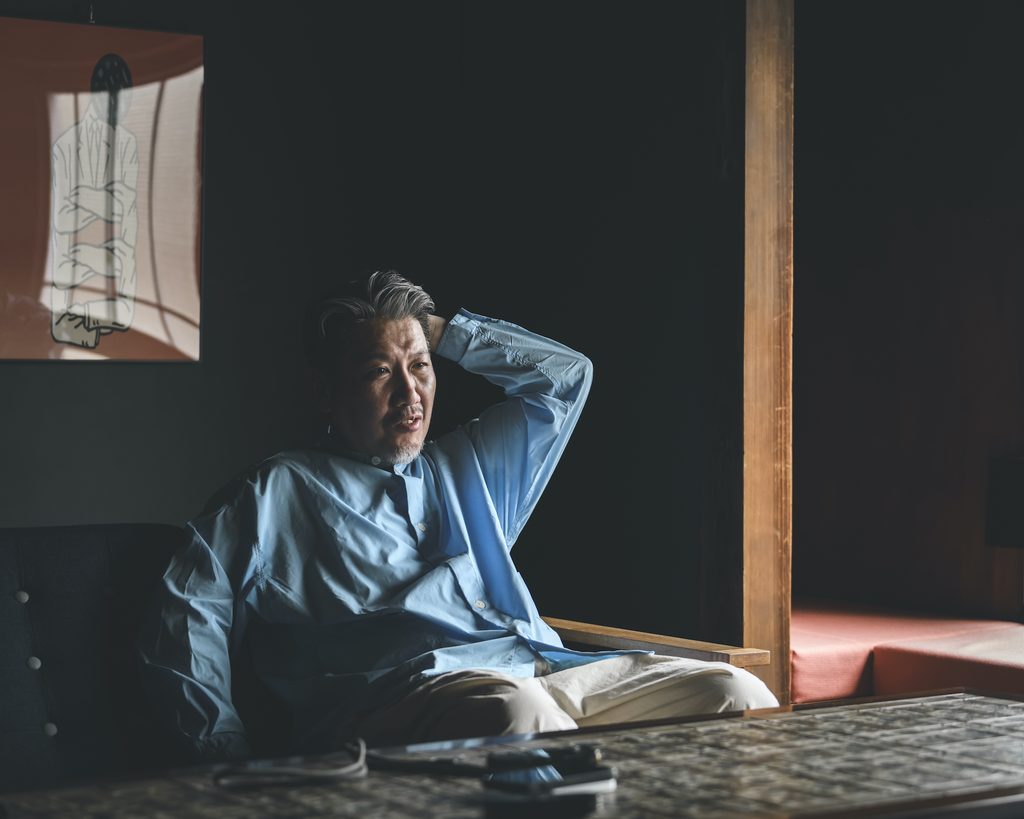
Shigeta: When we held a kick-off meeting to decide the direction of the brand, while various creators were making stylish presentations in PowerPoint, what Tetsu-san did was to show the artwork of abstract artist Toko Shinoda (see note) and say, “When it comes down to it, this is what Kazu really wants to do, right?” The whole room went completely silent for a moment, and everyone there was like, “Exactly.” And that was the end of the meeting. (laughs)
Uehara: At the time, Toko Shinoda was still actively creating even though she was over 100 years old. I was fascinated by the modernity of her work, which fused calligraphy and Japanese painting, and thought, “This old lady is incredible.” When I saw her work, I was convinced that it would resonate perfectly with the sensibilities around flower arrangement, tea ceremony, and the Japanese aesthetic that Kazu had within him.
Shigeta: Tetsu-san’s suggestion completely installed Toko Shinoda in my mind. She went to New York alone at 42, absorbed new cultures and ways of thinking in the United States, and established her own unique form of abstract expression through ink. In that sense, her style, which moved back and forth between the modern and the traditional, resonated perfectly with the aesthetics I had developed and the kind of world I wanted to create.
OSAJI’s brand image begins with medical practices from the Edo period and brings them together with ideas from modern lifestyles and science. So when Tetsu-san said, “That’s Toko Shinoda!” it was only natural that I thought, “Exactly.” Even now, Toko Shinoda’s aesthetic continues to run deep at the core of OSAJI’s worldview.

“Two amateurs who had held on to their youthful dreams for 20 years, weathering all kinds of twists and turns along the way, finally felt rewarded after turning 40.” (Shigeta)
——Mr. Uehara, you also designed the logo for OSAJI.
Uehara: I wanted to keep the logo as simple as possible. At the same time, though, I absolutely wanted to incorporate a symbol of a saji, or a spoon, into the design. I was so particular about that — you could almost call it a sense of mission. I think I came up with countless variations, trying to figure out how to make it all work.
As a designer, showing the trial-and-error process to someone is inherently a little embarrassing. That’s why I still rarely show that kind of thing to anyone. But in the case of OSAJI, I repeatedly showed Kazu different ideas, took his feedback into account, and went back and reworked the design. Of course, it wasn’t just my design, but I think the trust between us was what made me willing to work that way.
Shigeta: The logo we created that way was included in a 2018 design book featuring outstanding logos from Japan, Jitsurei-tsuki Logo no Design (Logo Design with Examples), published by PIE BOOKS.
Uehara: I was overwhelmed by emotion at the time. A bad boy from Takasaki who hadn’t attended art schools, together with his friends, had taught himself his way forward — and the result was recognized by the world. It really made me feel, “Even someone like us can do this.”
Shigeta: It was the moment when two amateurs who had held on to their youthful dreams for 20 years, weathering all kinds of twists and turns along the way, finally felt rewarded after turning 40. It felt as though we had finally made it to the top of a big mountain. We had created several cosmetics brands before that — although we could make them, they just didn’t sell. After those barren years, I finally felt we had created something people actually wanted.

——The logo for OSAJI’s new location, “OSAJI Kyoto,” which opened this April, was designed not by Mr. Uehara, but by Ms. Seri Tanaka, an art director who appeared in the previous volume of Idealism. Why didn’t you ask Mr. Uehara to design it?
Shigeta: Because, with OSAJI Kyoto, the subject isn’t me — it’s OSAJI. That naturally means we need a more democratic process that includes the thoughts and perspectives of the staff involved. That’s the main reason. Recently, OSAJI has started to move beyond my personal control, with the brand itself beginning to take on a life of its own — as if it were a person in its own right. In fact, even when I propose something I want to do, that “personality” called OSAJI often tells me no. (laughs)
In one sense, I feel I’ve done what I set out to do — I’ve created a park where lots of people can come and play. At the same time, there’s something complicated about the feeling that I may no longer be able to play in the park I created myself…
Uehara: As for OSAJI Kyoto, I saw it and thought, “OSAJI has become independent.” It has moved beyond Kazu’s hands, and things are starting to take on a life of their own through this personality called OSAJI. I think that’s proof that the brand is growing in a healthy way. Before, Kazu and I would work on little things together, but when it comes to OSAJI, I don’t think there’s any need for that anymore.

“In this life, I avoided the things I was not good at and made it this far by relying solely on my own sense, which allowed me to compete with anyone on equal terms.” (Uehara)
Shigeta: If there’s one thing that I can give myself credit for in what I’ve done with OSAJI, it’s that I’ve continued to stand somewhere between the creative pressure coming from Tetsu-san and the business pressure coming from my father. If I had leaned entirely toward the creative side, I wouldn’t have been able to maintain the relationship Tetsu-san and I have today — and, in the first place, the brand itself would have gone out of business. Rather than leaning toward either side, that sense of balance — resisting both and adapting to each when necessary — is part of what gives OSAJI its character as a brand.
——Perhaps that’s precisely because you’ve continued to stand in the middle that you’ve been able to satisfy both sides — making you an entertainer in the truest sense.
Shigeta: Maybe so.
——The two of you have forged your own paths through self-taught knowledge, without formal training in design, business, or cosmetics. If a young person asked if they should go to art school or vocational school, what would you say?
Uehara: I’d answer immediately, “You should go.”
Shigeta: I feel exactly the same way. If you have the opportunity, you should absolutely go.
Uehara: Actually, my son has been saying he wants to go to art school. He originally wanted to become an animator, but after making a sculpture in his high school art class, his teacher praised it so highly that he suddenly started saying, “I’m going to art school!” As a parent, I wondered, “Can he really do it even if he’s not particularly good at studying?” But if being praised by someone has given him the desire to pursue art, then there’s no reason not to go. This is his chance, so I’m encouraging him to go for it while he can.

Shigeta: That’s a really fortunate experience. No one evaluated us when we were young, and by the time we realized it, it was already too late — we couldn’t go to university at that point in our lives. But I want to make it clear that even people like us, who never went to a specialized school, can still stand in front of a classroom and teach.
Recently, I’ve had more and more opportunities to teach classes at elementary and high schools. That’s the work I find most rewarding and enjoyable. The other day, I gave a lecture at my alma mater, The Second High School, Tokyo University of Agriculture. The class was limited to 20 students, but nearly 50 applied to attend. I held a 90-minute workshop on blending fragrances.
I think the students enjoyed the workshop itself, but I also told them, “You should stop thinking too much about your vision or goals for the future — because that can change by tomorrow. More than anything, you should focus on what you’re interested in and what you can really immerse yourself in right now, and give it everything you’ve got.”
Afterward, quite a few students wrote to me, saying things like, “I had been thinking so much about what I should do now for the sake of my future that I’d lost sight of what I actually wanted to do. But listening to Mr. Shigeta’s talk really gave me courage.” That’s also at the heart of what Tetsu-san and I have been doing all along. So if that message came across, I feel it was really meaningful.
Uehara: That’s exactly right — “Give yourself fully to what you want to do today.” You never know what tomorrow will bring. But in my case, in this life, I avoided the things I was not good at and made it this far by relying solely on my own sense, which allowed me to compete with anyone on equal terms. If I had another life, I’d definitely do something completely different. I think a life where I apprenticed at a sushi bar and trained as a sushi chef could be pretty fun.
——What does the word “sense” mean to Mr. Uehara?
Shigeta: I think what he means by “sense” is a kind of instinct. Anything he says, “This is good,” eventually turns into a trend a few years later. He would say, “This is good. Give it a listen,” and I would think, “Huh?” — but a few years later, those things always end up selling well. That ability to sniff out what’s going to catch on — that’s the sense Tetsu-san is talking about.
If we hadn’t closed arizona forty-five degrees (see note) after just one year and had kept it going, we might both have become legends. In that sense, we did have some foresight — the problem was that we couldn’t sustain it. (laughs)
Uehara: It was still the dawn of the internet, and there was nothing like Spotify yet, but I had already predicted that an era of selling music through MP3 downloads would come. I said, “Online distribution will become the primary way people enjoy music, and physical CDs will be nothing more than an extra bonus.” And that’s exactly what happened, right?

“I’m convinced that the idea of continually renewing yourself through intellectual resources, and this format of travel, will definitely catch on in the years ahead.” (Shigeta)
——Let me ask both of you this, given your talent for seeing what’s ahead: What do you think is something we should be working on now with an eye toward the next five years?
Shigeta: That’s exactly the project of SHIRAKABASō (see note), for which Tetsu-san designed the logo. SHIRAKABASō isn’t just a place to take a vacation — to soak in hot springs, enjoy three meals a day, and sleep whenever you like. It’s a place for what we call an “educational trip”: a journey where you gain new inspiration through experiences and come away with a different approach to your lifestyle and work from the very next day.
Demand for this kind of travel is growing around the world, but perhaps because Japan is behind the curve, we’ve had almost no bookings. (laughs) Still, I’m convinced that the idea of continually renewing yourself through intellectual resources, and this format of travel, will definitely catch on in the years ahead.
——What are your thoughts on education trips, Mr. Uehara?
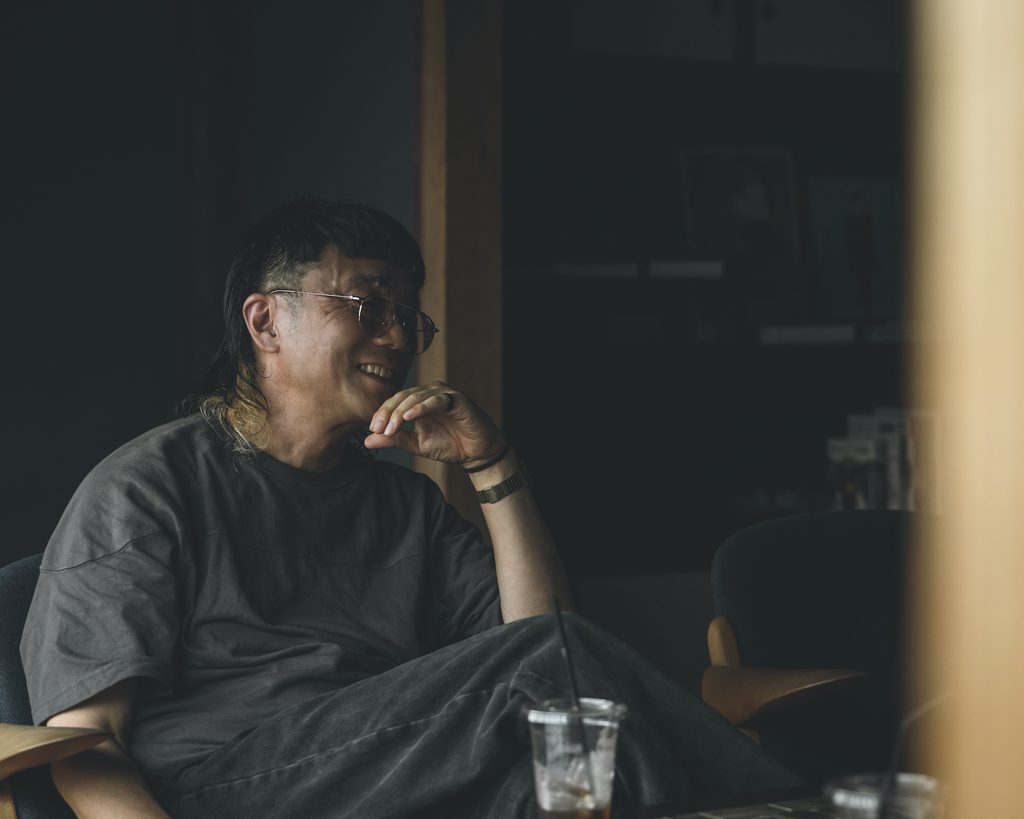
Uehara: I understand what he means. He wants to create a kind of trip where the destination itself offers something to learn — not one where the hot springs are the main attraction. But the way I spend my own free time is the complete opposite. On Netflix, I watch really low-budget Japanese romance dramas — the kind you’d call ultra C-grade or B-grade. On YouTube, I mostly watch trending vertical short dramas. I’m the type who likes to follow trends.
Shigeta: On my day off, I don’t really want to watch anything too casual. I’m only interested in things that spark ideas or inspirations, or that might lead to my next business idea. I can’t help but feel that there’s nothing more wasteful than passively watching whatever happens to be on.
——There’s a Japanese expression, “to return to hometown in glory.” Now that you’ve achieved a certain degree of success, Mr. Shigeta, do you have any desire to team up with Mr. Uehara and bring some excitement back to Takasaki?
Uehara: When we were chatting outside earlier, you said, “Maybe I can buy the building where arizona forty-five degrees used to be.” It would be really interesting if you took charge of the whole block where the building stands.
Shigeta: I don’t have that kind of energy anymore. (laughs) But the Takasaki we knew in the ‘90s was really something. Every little side street was packed with street-level shops, and there were so many people walking around that you could barely avoid bumping shoulders. It had so much energy that you’d think, “Is this Harajuku?” There were also several legendary vintage clothing shops, so young people would come all the way from far away.
Uehara: Yeah, it was incredible. Vintage clothing was at its peak.
Shigeta: In that sense, even though times and the shape of culture have changed, there may still be something only we, who have watched this city change over the years, can do. Maybe we can find our own way to bring to life the culture, products, and places we genuinely find interesting. Talking like this at length, I realized once again that, at our core, neither of us has really changed since we first met. That was really interesting to realize.
Uehara: I had a great time today, too.

Notes:
*1_Toko Shinoda
Toko Shinoda is a Japanese artist born in 1913 and passed away in 2021. Moving beyond calligraphy, she developed a unique form of abstract expression that transcended written characters. She moved to the United States in her 40s, where she gained international recognition, particularly in New York. Her modern, delicate works, created with Japanese paper, ink, and silver leaf, are known for their unique aesthetics, fusing traditional Japanese beauty with contemporary art. She continued creating well into her 100s. The conversation between Shigeta and Uehara revealed that Shinoda’s artwork had a decisive influence on OSAJI’s brand concept and the formation of its worldview.
*2_arizona forty-five degrees
A combined apparel shop and live venue that operated for about a year from the end of December 1999, with the apparel shop on the first floor and the live venue on the second. Before opening, Shigeta, Uehara, and others spent a year completely renovating the space themselves, doing everything from cutting steel plates to installing electrical wiring. The building still stands at 156 Motomachi, Takasaki City, but there is no way to tell what it looked like back then.
*3_SHIRAKABASō
A private lodging facility limited to one group per day, SHIRAKABASō is housed in a former study hall built in 1963 and renovated for a new purpose. Located in the Sarugakyo Onsen area in Minakami, Gunma Prefecture, it offers not simply a sightseeing trip or a chance to relax, but an “educational trip” — a journey of learning through which guests gain new inspiration from the experiences they encounter during their stay. Guests can step away from everyday life and reconnect with their senses, enjoying quality time through experiences such as preparing and enjoying meals in the symbolic kitchen featuring a table made from a 150-year-old slab of wood, relaxing in an authentic wood-fired sauna, and soaking in the natural hot spring water, while discovering what works best for themselves.
Profile
-
Tetsuya Uehara
Born in Gunma Prefecture in 1973, Tetsuya Uehara began his career in the early 1990s, when his hand-drawn T-shirts featuring skateboarding culture and tattoo design drew attention in the street scene and led him into apparel design. In 1998, he held his first solo exhibition.
His relationship with Masakazu Shigeta began when he commissioned Shigeta to frame one of his works. At the end of 1999, they opened a combined shop called “arizona forty-five degrees,” with the apparel shop on the first floor and the live venue on the second. Around this time, Uehara began teaching himself digital tools, including the Mac, as well as DTP and printing techniques.
Alongside running the shop, he began taking on design work. Later, he worked as an in-house designer at Nitto Denka Kogyo before becoming independent in 2006. In 2011, he established Mountain Name Inc., where he currently serves as the president. When OSAJI launched in 2017, he handled everything from naming the brand to its logo, packaging, and overall graphic design. His recent works include logo design and branding for Kako, Hege, and Shirakaba-so.
Unbound by conventional design theory, Uehara quickly senses his clients’ true intentions and the mood of the times through his intuition and instinct. With a raw, unpretentious sensibility and a sharp eye, he specializes in transforming ideas into forms that exceed his clients’ expectations. His office name, Mountain Name, comes from Yamana-machi in Takasaki City, where Uehara was born.
https://mountain-name.com -
Masakazu Shigeta
Shigeta began his career in a technical role in the music industry before becoming a cosmetics developer in 2001. Beginning in 2004, he led the development of various cosmetics brands within the healthcare division of Nitto Denka Kogyo Co., Ltd., a metal surface treatment company founded by his great-grandfather. In 2017, he founded OSAJI, a skincare lifestyle brand, and became its brand director. In 2021, as a new store under the OSAJI brand, he launched kako, a specialty shop dedicated to home fragrance blending, and in 2022, he opened OSAJI’s first restaurant, enso. In 2023, leveraging Nitto Denka Kogyo’s technical expertise, he launched HEGE, a tableware brand, and became CEO of OSAJI Inc. in October of the same year. In 2026, as a personal project, he opened Shirakabaso, a private rental lodging facility in Sarugakyo Onsen, Gunma Prefecture, and launched OSAJI Kyoto, the brand’s global concept store in Kyoto’s Gosho Minami district. In the same year, he launched soca, a fragrance brand rooted in Japan’s unique aesthetic sensibilities. He has published books on beauty and regularly holds cooking classes and events focusing on food as the foundation of beauty.
Publications
Taberu Biyou (Eating for Beauty) (SHUFU TO SEIKATSU SHA, 2024)
42-Sai ni Nattara Yameru Biyou, Hajimeru Biyou (Beauty Routines to Quit and Start at 42) (Takarajimasha, 2022)
-
Photographs:Eisuke Komatsubara
-
Text:Masahiro Kamijo
-
Location:Motomachi Shimotaya

NEWS LETTER
理想論 最新記事の
更新情報をお届けします
ご登録はこちら
ご登録はこちら
メールアドレス
ご登録ありがとうございます。
ご登録確認メールをお送りいたします。