
2026-07-23
Vol.29
Art Director and Graphic Designer
Seri Tanaka(part 2)
-
Breaking Free from Sampling Culture
-
Design That Doesn’t Reveal Itself at First Glance
-
From Client Work to Collaboration Work
-
Aiming for Someone’s 100, Not Everyone’s
-
Letting Go of the Need to Look Cool
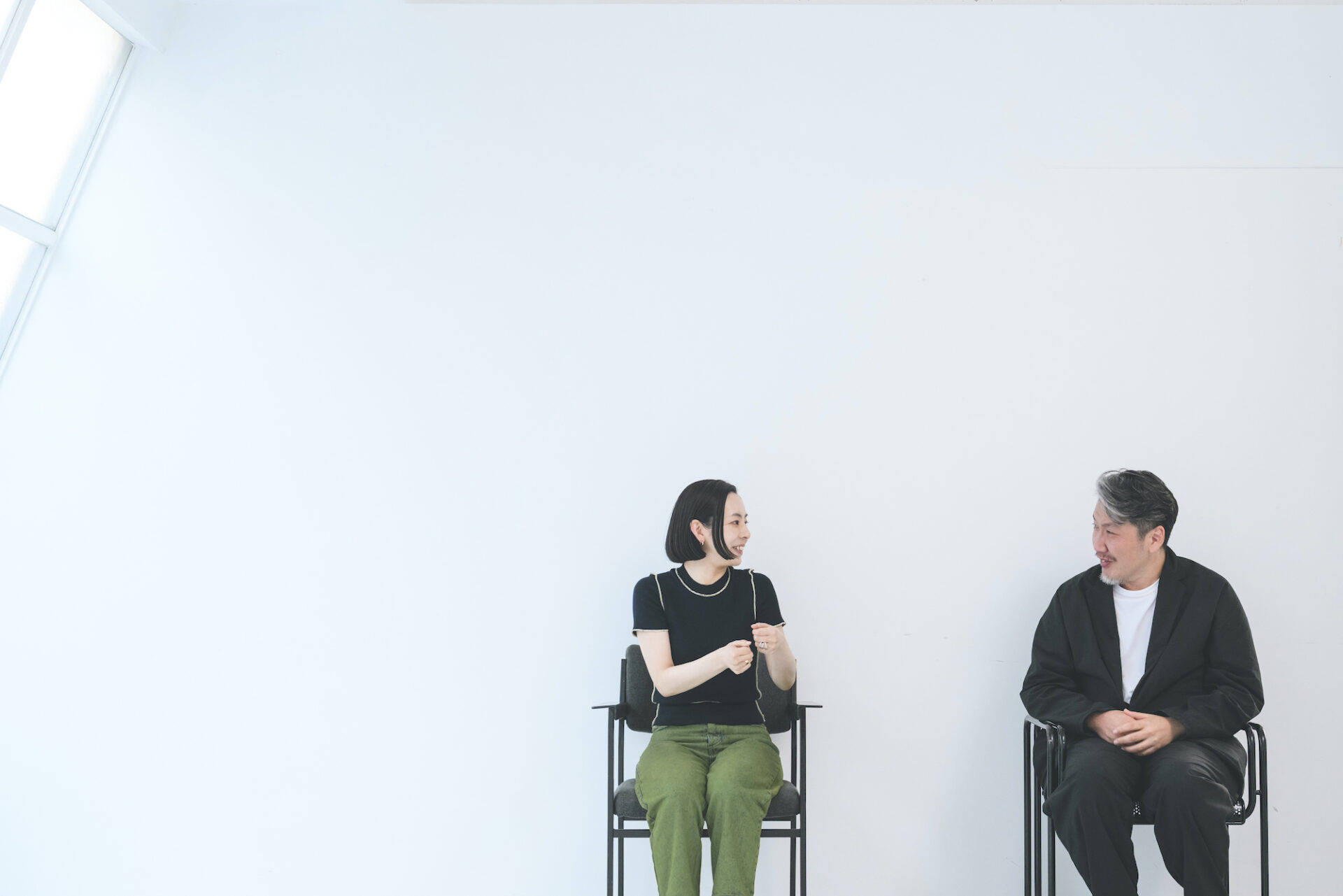
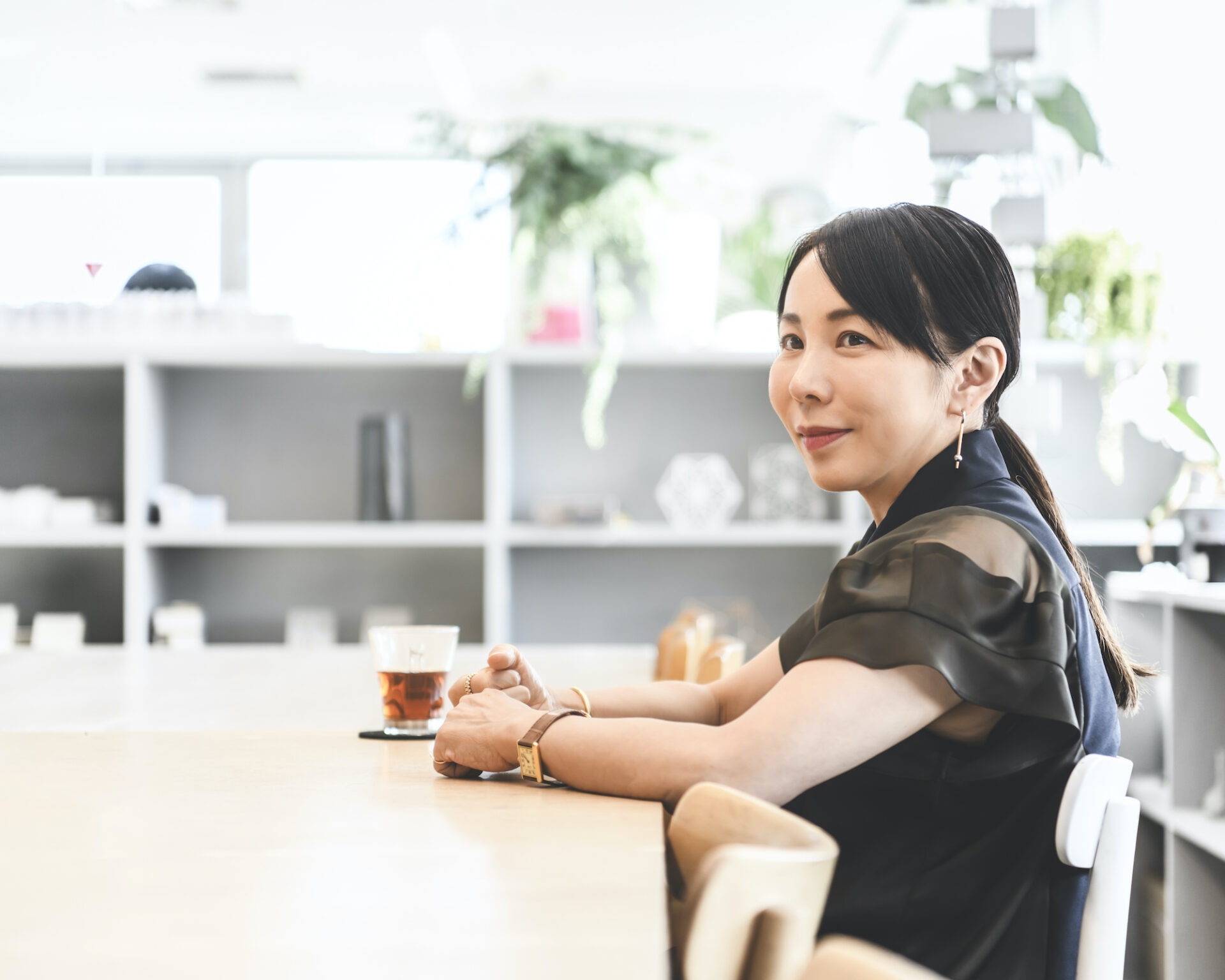
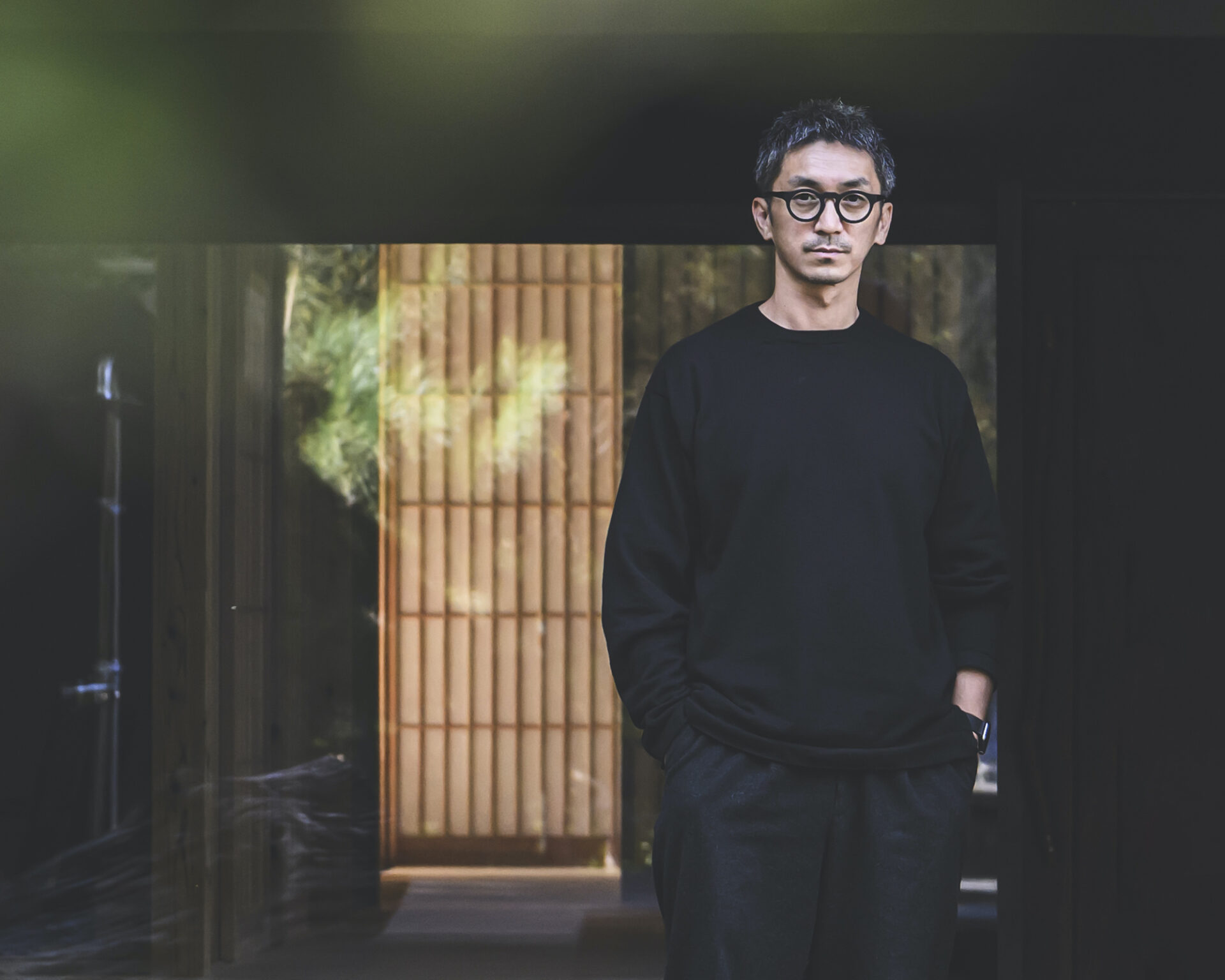
In April 2026, the cosmetics brand OSAJI opened its global flagship store, OSAJI Kyoto(*1). Set within a former sake brewery dating back 245 years, at the heart of the space is a new logo — one whose meaning does not reveal itself at first glance. The logo was designed by Seri Tanaka, an emerging figure known for her work in corporate identity, branding, and artwork. Why did Masakazu Shigeta, the founder of OSAJI, entrust her with the crucial task of creating the flagship store’s visual identity? Through their conversation, they explore an approach to making things that leave a lasting impression — one that could never emerge from efficient requirements documents or technical specifications. Their dialogue dissolves the boundaries between business and creativity, revealing the essence of collaboration for a new era.
(Click Here for the First Part of the Interview)
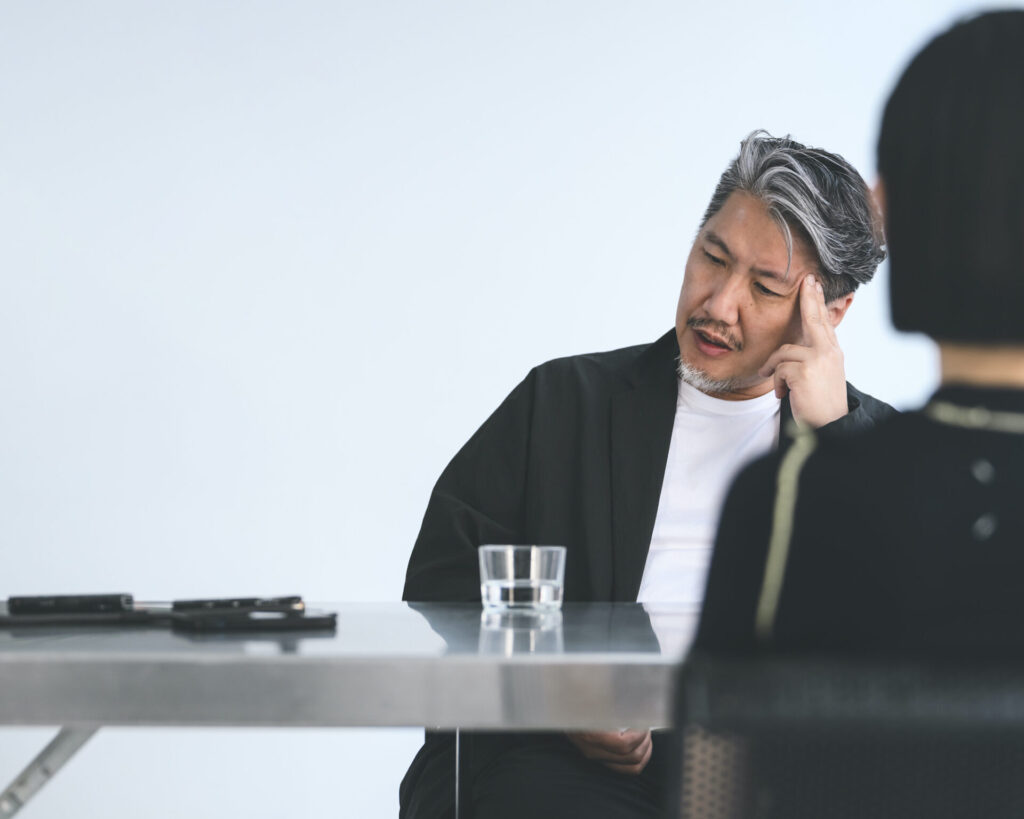
“Across the creative field as a whole, I feel that sampling culture has become far too dominant.” (Shigeta)
——Ms. Tanaka, you’ve said that through design, you’re always hoping to discover who you are now, as well as a new side of yourself. Looking back on this project, was there anything that made you feel you’d discovered something new about yourself or broken through one of your own boundaries?
Seri Tanaka: Well, in this project, I had the opportunity to be involved in the realm beyond the usual scope of graphic design. I discussed things with the team, such as which plates we should use to serve customers, what shape the trays should have, and even what materials they should be made of. In addition to visual design, I was involved in shaping the overall setting of the space — thinking about how time should be experienced and what quality of light would feel right. Having the opportunity to contribute to that broader kind of design was a completely new experience for me.
Masakazu Shigeta: As she just mentioned, the attitude of challenging new realms unbounded by conventional frameworks is something I consider quite important in creativity. Recently, when I ask someone for a design, I’ve made it a condition to “stop thinking about it only as an extension of the past.”
The reason is that, not just in design but across the creative field as a whole, I feel that sampling culture has become far too dominant. With so many ideas already out there in the world, we’ve reached a point where creativity is often seen as a matter of choosing what to sample or collage and how well to do it. But everything produced through sampling — however pleasant to the ear, pleasing to the touch, or easy on the eyes — is ultimately a form of predictability.
From an economic rationality standpoint, predictability is clearly the safer choice because more people can understand it and more of them will say they love it. But when you look back decades later, I believe nothing stays in the memory. When I asked her to design the logo, I said, “Let’s break free from nostalgia” — and part of what I meant by it was breaking free from that sampling culture.

“When I design a logo, I sometimes arrange the elements so they can’t be read at first glance. That brief moment of “Huh?” makes people pause.” (Tanaka)
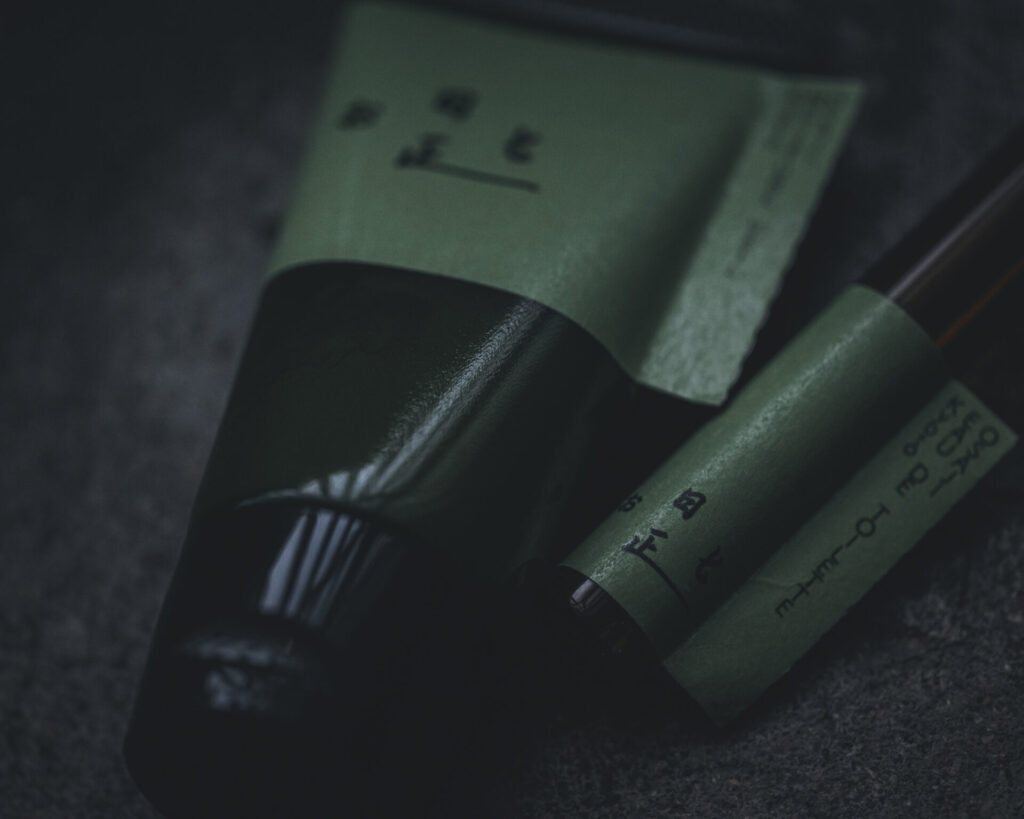
——The logo for OSAJI Kyoto begins with the character “O,” while the elements deconstructed from the kanji 匙 (Saji) are arranged in a diamond-shaped composition. I think many people would recognize that playful approach to typography as something distinctly Tanaka-esque.
Tanaka: When something appears in an Instagram feed, if it’s so straightforward that you can understand it at a glance, people often just scroll past without really seeing it. The same is true of stylish, trend-driven cafe logos. People immediately think, “Oh, it’s that kind of design,” file it into a familiar category, and never really look at it again.
That’s why, when I design a logo, I sometimes arrange the elements so they can’t be read at first glance, because the moment someone tries to figure it out, they’re already engaging with it. It’s like creating a small opening for the design to slip quietly into their mind. That brief moment of “Huh?” makes people pause.
The OSAJI Kyoto logo works in that way as well. I sometimes deliberately use the Roman letters vertically, or use them almost like furigana — phonetic annotations used in Japanese — rather than simply as text. I enjoy experimenting with those kinds of typographic arrangements.
——While the logo you designed for the Senkin project(*2) functioned like a symbol mark, the OSAJI Kyoto logo is centered around typography, yet it isn’t simply a handwriting font. It feels as though it exists somewhere between a symbol and a piece of lettering.
Tanaka: At first, I thought using kanji might be a little unfriendly because Kyoto is a place many people from overseas visit. Many sushi restaurants with a wonderful atmosphere have names written in just three hiragana characters. But I worried that something like that would simply blend into the scenery and be passed over. So I came full circle and landed on kanji as the better choice after all. In the end, I was aiming for something that functions as a symbol mark while still remaining legible as text — a hybrid of the two.
——Mr. Shigeta, do you see the OSAJI Kyoto logo becoming part of OSAJI’s identity as the brand expands internationally?
Shigeta: Well, that’s hard to predict. First of all, when I started OSAJI, I wasn’t thinking about expanding overseas, not even a little. It was only after we accepted investment from a trading company and became independent from our former parent company that international expansion entered the picture. Over the past two years, we’ve been focusing primarily on Taiwan.
Once we actually began expanding overseas, inquiries started coming in from all over the world, and I found myself traveling more often to see those markets firsthand. What struck me most was that, if we truly want to create products that resonate globally, we need to fundamentally rethink our philosophy of making things. I don’t think superficial, market-specific customization is the answer. The real question is, what does a genuinely Japanese identity look like when you step onto the global stage? Ironically, the identity becomes weakest when you’re creating solely for the Japanese market — because the market here is still deeply shaped by an admiration for European and American culture. The more you optimize for the domestic market, the more you end up imitating the West — and in that process, Japan’s unique strengths begin to disappear. Standing on the front lines of the market, you can’t help but confront that reality.
Ramen — Japanese noodles — is a good example. Today, it has become a food that can compete on the global stage. While the format originates in China, what has earned its global appreciation is its underlying spirit — craftsmanship and an uncompromising attention to detail — which is unmistakably Japanese. If the format were ramen but the spirit were merely an imitation of Europe, I don’t think anyone overseas would pay much attention to it.
That’s what interests me about this project in Kyoto — how do people feel when they encounter the logo Ms. Tanaka designed, or the products that bear it? Whenever I stand in front of that logo, I naturally find myself standing a little straighter, feeling a renewed determination. It also changes the way I approach the products themselves. One of the reasons I’m so eager to expand the range of products that carry this logo is because of its remarkable ability to move people.
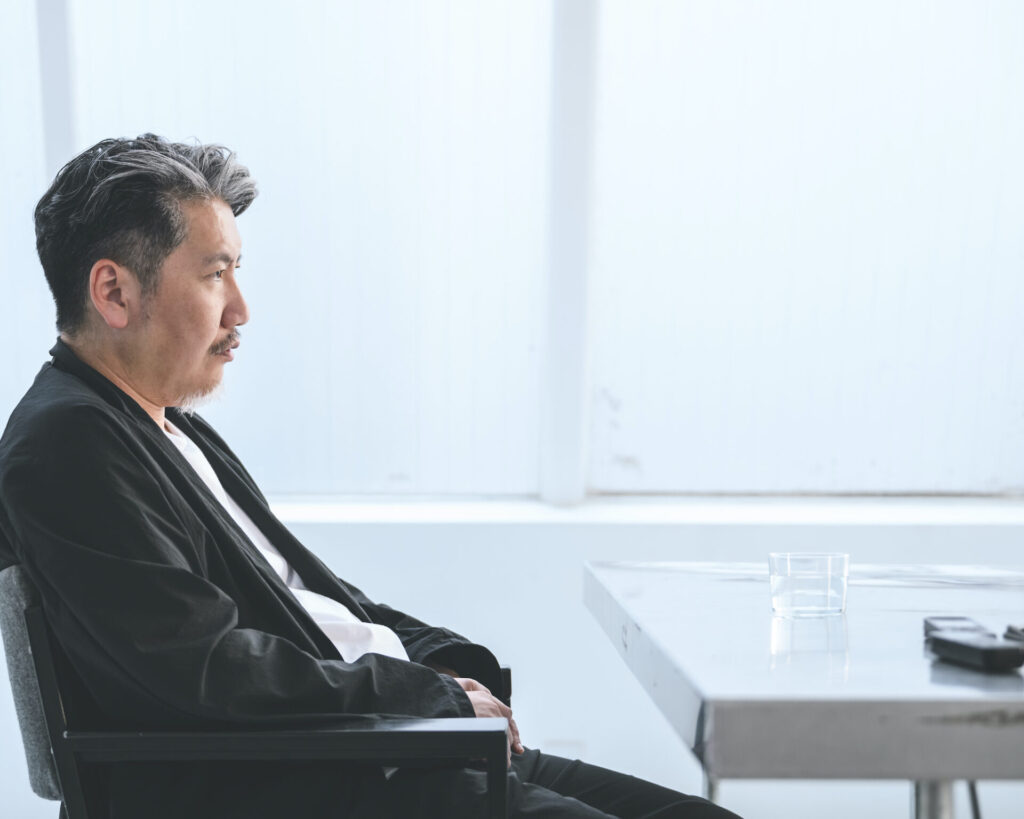
“There has to be a certain distance between clarifying the conditions and actually making something with your own hands. Otherwise, the work never really has a soul.” (Shigeta)
——Ms. Tanaka, speaking about this logo, you once said that “I just established a framework, then left room to choose from whatever emerged through experimentation.”
Tanaka: Previously, I created an artwork titled Typography of Shadow. There, all I did was to choose the typeface, and the shadows themselves are created by the sun. It’s a collaboration between the sun and me. I created it with the hope of discovering things that emerge beyond my own intentions or ego.
Shigeta: Listening to you just now made me curious about one thing — how do you maintain a certain distance from the kind of requirements your clients give you? Quite often, you come across projects where the requirements are beautifully organized, yet the final design somehow fails to resonate. You think, “Everything was defined so neatly, and this is what came out?” It happens more often than people realize.
There are many books about how to define requirements, but reading them won’t make someone more creative or give them better taste. Of course, I also spend time organizing requirements, but I believe there has to be a certain distance between clarifying the conditions and actually making something with your own hands. Otherwise, the work never really has a soul. I’m curious how you create that distance when you’re working with clients.
Tanaka: Of course, I don’t ignore requirements, either. But what matters more is finding what can’t be uncovered through requirements definition — the things that make us feel “This is what we should be paying attention to right now” — and sharing that perspective. It could be a moment that moves you, or simply something that leaves you with a lingering sense of unease. To me, creating a “jumping-off point” means noticing and capturing those things.

Shigeta: While Ms. Tanaka uses the expression “setting a jumping-off point,” I’ve been using the word “resonance” more often recently. When you encounter a work of art and feel instinctively that it’s excellent, no explanation is needed. That, to me, is what it means to find a point of resonance. I truly believe we should avoid meetings that serve only as status updates or that exist simply to formalize consensus that everyone already sees coming. To me, the only meetings worth having are those that involve brainstorming.
Just recently, one of our staff members said, “If we’re going to do that, we’ll need a specification sheet.” So I told that person, “Why not stop working from a specification sheet altogether?” Let’s have meetings where everyone reaches that point of resonance instead. If there’s a moment when everyone lights up and says, “Yes, that’s it!” — the project will move forward on its own without any specification sheet, and people involved will really enjoy it. That’s exactly what “setting a jumping-off point” means to me — the process of finding that point of resonance.
Tanaka: The very moment you say “We need a specification sheet,” the project starts to feel like you’re simply helping someone else to do their job. In a sense, all client work can become like that. But I try to avoid it as much as possible. Ideally, the project should become part of my own creative practice.
OSAJI Kyoto was exactly that kind of project. We worked with a very small team, and there was a real sense of momentum and shared energy. Even if no one asked, if I thought something could be improved, I could speak up with no hesitation. The same was true of the lighting in the space — whenever I noticed something, I didn’t hesitate to share my thoughts with the team.
The moment that kind of openness emerges naturally, you realize you’ve reached a point of resonance. It no longer feels like you’re simply working for a client. The project becomes half yours as well. At that point, what began as a job gradually turns into a personal creative activity. Everyone is making something they genuinely want to make. To me, that’s the ideal design process.
——Perhaps the term client work itself carries the implication that the creator is simply there to execute someone else’s vision, rather than becoming a genuine stakeholder in the project.
Tanaka: Exactly. That’s why I always remind myself to think of it not as client work but as collaboration work. It’s not about simply responding; it’s about resonating with each other’s ideas and creating new value together. Otherwise, it’s difficult to build a lasting relationship as creative partners. Whether both sides can bring that same level of passion and commitment to the project is, I think, one of the most important aspects of making something meaningful.

“Once you adopt that simple mindset, the work naturally has a longer lifespan and becomes something that genuinely belongs to you as a designer.” (Tanaka)
——Mr. Shigeta, you’ve spoken before about how, based on your own experience, work is only meaningful when everyone involved genuinely enjoys it. You’ve even joked that you sometimes end up putting pressure on your team to enjoy themselves.
Shigeta: If you’re truly walking the path you want to follow, enjoyment should come naturally. If it doesn’t, then it starts to feel as though you’re simply being forced to do something. That’s why I always tell our team to approach their work with a sense of ownership.
This sense of ownership is especially important in creative work. I have a strong policy that, rather than aiming for an 80 out of 100 for everyone, we should strive to create something that’s a perfect 100 for someone. In a team made up of people with different sensibilities, it’s impossible to create something that everyone considers perfect. But if we settle for a safe 80 by chasing the greatest common denominator, no one ever reaches the “jumping-off point” we were talking about, and the creator’s sense of ownership disappears.
That’s why I work closely with the people responsible for product development, encouraging them to create something that will be someone’s 100. That doesn’t mean ignoring opinions from other departments. We embrace ideas that genuinely make the work better, and we aren’t afraid of rejecting those we don’t agree with. If you have the conviction to make those decisions, the work naturally becomes more enjoyable.
Creative work driven by a strong sense of purpose may seem like an 80 when it’s first completed. But as more people engage with it and invest their own feelings in it, its value continues to grow over time. Years later, you may find yourself looking back and thinking, “Well, this has become something very close to a perfect 100.”
Tanaka: I really relate to that idea of aiming for someone’s 100 rather than everyone’s 80. There was a time when I believed that my job was to satisfy everyone’s requirements and minimize everyone’s stress — to arrive at that safe 80. But I no longer think that’s what good design is.
When I worked on the Senkin project, I realized that there are really only one or two people who truly needed to be delighted by the outcome. It struck me how simple that actually was. Once you adopt that mindset, the work naturally has a longer lifespan and becomes something that genuinely belongs to you as a designer. So what you just said really resonated with me.
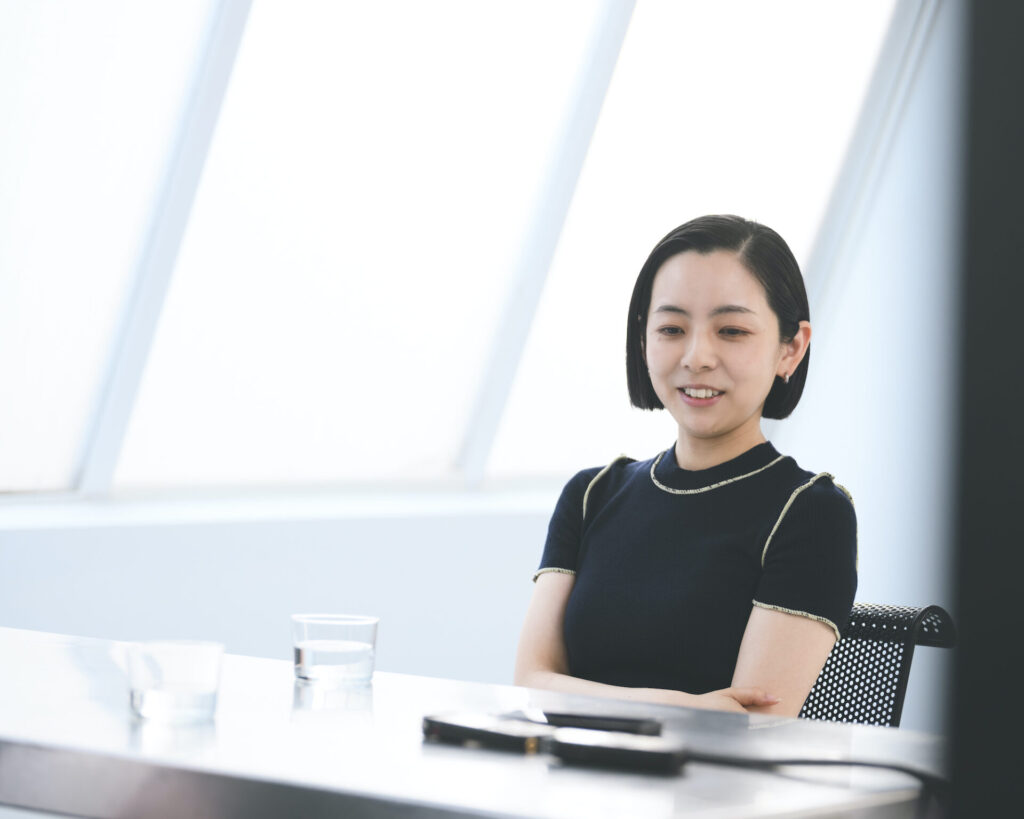
“My biggest insecurity might be the tendency to try too hard to make things look cool.” (Tanaka)
——Let me ask a question to both of you: Is there a personal insecurity or challenge that continues to motivate you in your work?
Shigeta: In my case, I think it’s the feeling that I was never cut out to work in a conventional company, but that sense of not fitting in has also become one of my biggest driving forces. I quit a part-time job after just a week, and I didn’t stay long as a recording engineer, either. I carried a real sense of inferiority about being someone who could never stick with anything.
But looking back on it now, I realize what I really disliked was being in a situation where I had no authority to make decisions. When I worked the night shift at a convenience store, for example, I rearranged the schedule to make the work more efficient, only to find myself scolded for it.
In the end, it was precisely that awkwardness and those insecurities that forced me to move forward at my own pace. Like a tortoise, I had no choice but to keep going slowly until I eventually found a way of creating things through my own decisions. In that sense, I think confronting my own weakness and challenges has become the source of my motivation.
Tanaka: For me, my biggest insecurity might be the tendency to try too hard to make things look cool. Whenever I’m designing something, I reach the finishing stage and start thinking about how to make it more polished and more impressive. That’s when I end up adding things that don’t need to be there. I understand in my mind that something more human, something rooted in everyday life, is often better, but living and working in Tokyo — where information is constant and everything moves so quickly — I inevitably feel the pressure to stand out. That’s the part of myself I wrestle with every day.
Actually, I approached the OSAJI Kyoto project the same way at first. I thought I was going to make something really interesting, truly cool. But as I walked through Kyoto and spent time, and the moment I walked into the space that had stood there for 245 years, I suddenly felt, “No, this isn’t the place that I should try to make stand out.” It was honestly embarrassing. I realized I had been trying to make myself look bigger than the place itself.
In the end, the signature became nothing more than a small arrow that only those who notice it will notice — almost like the pencil marks on the corner of a wooden pillar recording a child’s height as they grow. Rather than putting the design up front and center, I wanted it to exist simply because it belonged there and was genuinely necessary. I think it was only because I physically came to Kyoto and experienced the place for myself that I was able to let go of my own ego as a designer. That was an incredibly valuable experience for me.
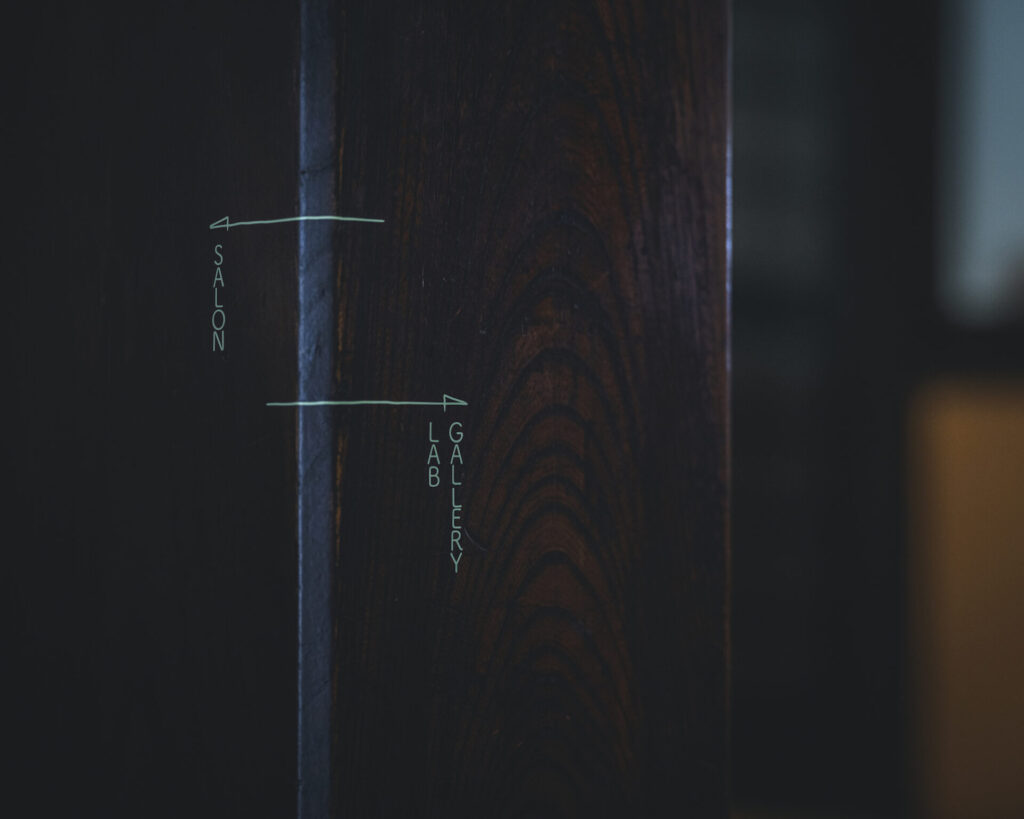
——Letting go of your own ego as a designer and moving toward a more essential way of shaping a place seems to be a breakthrough for you. Looking ahead, is there anything you’d like to challenge next?
Tanaka: I’d love to work on places that bring together every aspect of daily life — food, clothing, and living — and create that kind of all-encompassing environment. One of the entities I admire most is Assemble, the young architectural collective based in the UK. They’re well known for their revitalization project in Liverpool, but what fascinates me is that they don’t simply create finished work. They design the very framework for creative activity, as well as the place where it happens.
I’m drawn to that borderless way of working, where the outcome might be a product, or it might be an experience such as a workshop. Going forward, I’d love to be involved in projects from the very beginning — from the stage of developing the overall vision — beyond the scope of graphic design.
Shigeta: I’ve really enjoyed our conversation. It was a true pleasure hearing everything you shared. Thank you very much for joining us today.
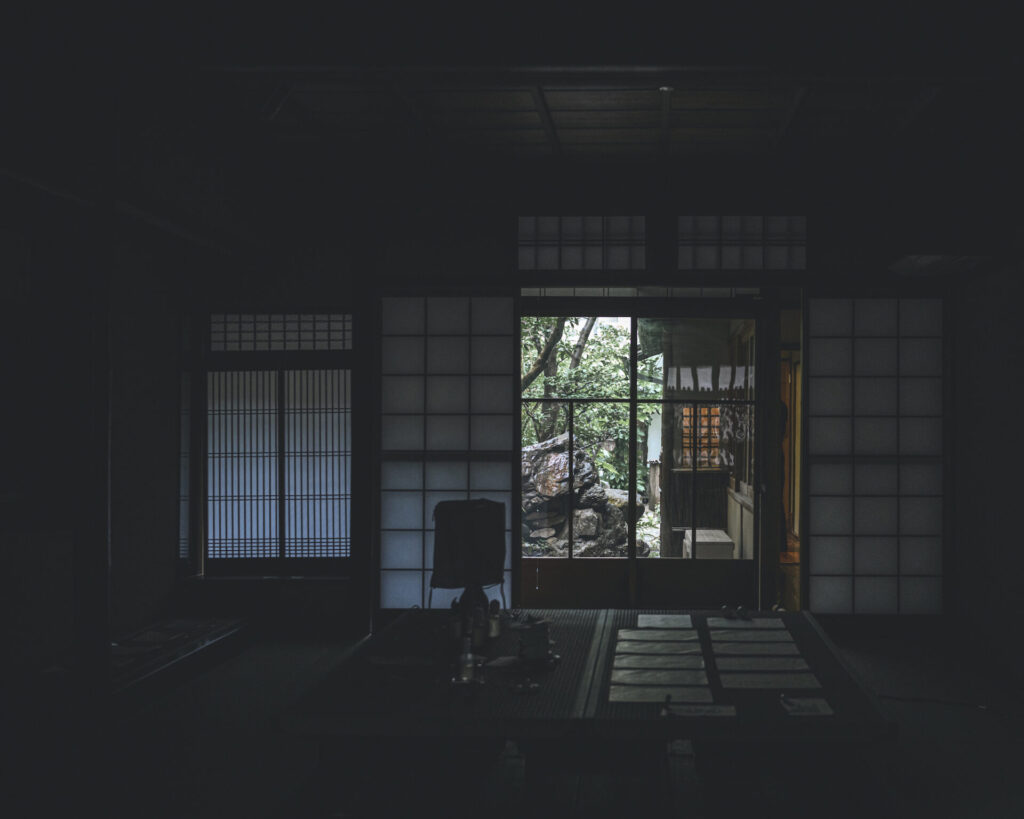
*1_OSAJI Kyoto
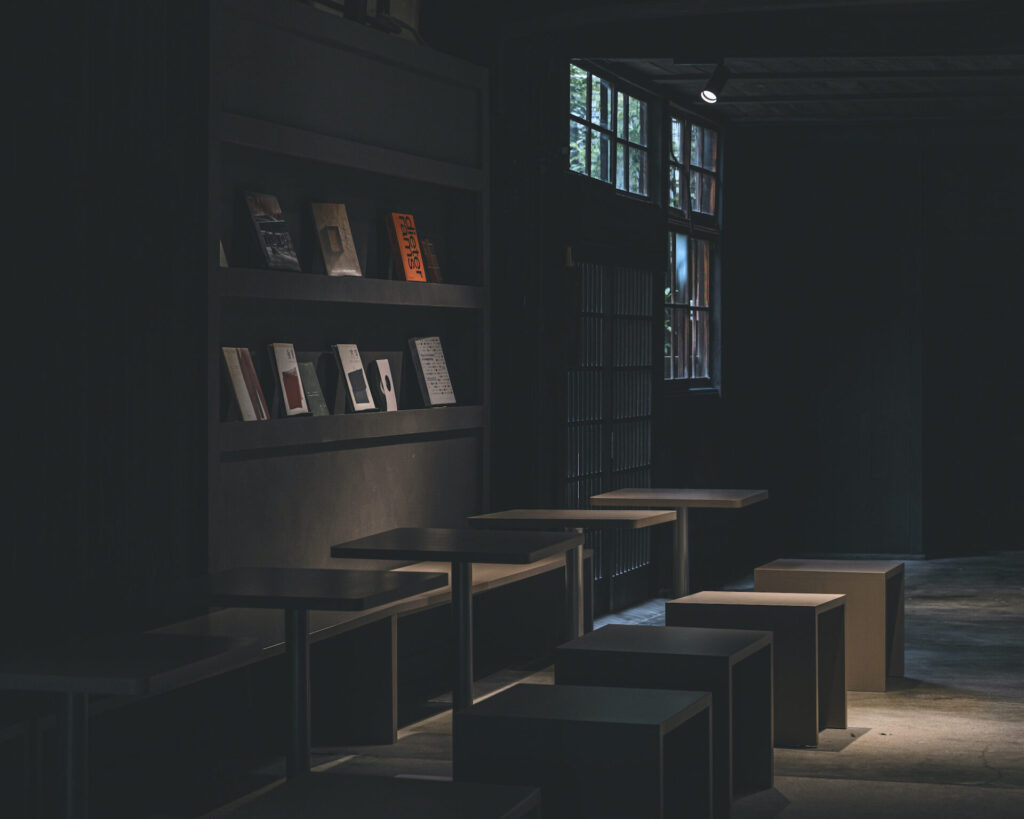
Opened in April 2026, OSAJI Kyoto is the brand’s first global flagship store. Housed in a 245-year-old former sake brewery, the building is also known for Momonoi, the celebrated natural spring that still wells up on the site and has long been used in sake brewing. While embracing the site’s history, the space deliberately departs from conventional expectations, presenting itself as a place for experimentation that carries the baton to the next generation. The architectural design was led by Shuzo Okabe, while the new logo created by Seri Tanaka serves as the store’s symbol, appearing on the noren curtains as well as on OSAJI Kyoto’s original products.
*2_Senkin Logo
Designed by Seri Tanaka in 2018, the logo for Senkin is named after the word for a crane that dwells in the celestial world. Its visual identity is defined by the red, white, and black coloration of the red-crowned crane. Praised for its fresh, fluid sensibility that breaks free from convention, the project became a major milestone in Tanaka’s career and led to her receiving the JAGDA New Designer Awards in 2020.
Profile
-
Seri Tanaka
Born in Ibaraki Prefecture in 1987, Seri Tanaka is an art director and graphic designer. Instead of treating design as a mere visual symbol, she explores the underlying aesthetic values and cultural context that a place or brand has cultivated. Her signature approach is to reinterpret existing assets and add another chapter to them through a flexible, structurally driven design process. Her major works include logo designs for the long-established sake brewery Senkin, Koumi-machi Kougen Museum of Art, and AMBIENT KYOTO. She is also known for her graphic design work for the alternative rock band Hitsujibungaku. In addition to her commercial practice, she produces personal photographic works exploring chance and serendipity. She has received numerous awards, including the JAGDA New Designer Award, as well as honors from Cannes Lions and the NY ADC.
https://seritanaka.com -
Masakazu Shigeta
Shigeta began his career in a technical role in the music industry before becoming a cosmetics developer in 2001. Beginning in 2004, he led the development of various cosmetics brands within the healthcare division of Nitto Denka Kogyo Co., Ltd., a metal surface treatment company founded by his great-grandfather. In 2017, he founded OSAJI, a skincare lifestyle brand, and became its brand director. In 2021, as a new store under the OSAJI brand, he launched kako, a specialty shop dedicated to home fragrance blending, and in 2022, he opened OSAJI’s first restaurant, enso. In 2023, leveraging Nitto Denka Kogyo’s technical expertise, he launched HEGE, a tableware brand, and became CEO of OSAJI Inc. in October of the same year. In 2026, as a personal project, he opened Shirakabaso, a private rental lodging facility in Sarugakyo Onsen, Gunma Prefecture, and launched OSAJI Kyoto, the brand’s global concept store in Kyoto’s Gosho Minami district. In the same year, he launched soca, a fragrance brand rooted in Japan’s unique aesthetic sensibilities. He has published books on beauty and regularly holds cooking classes and events focusing on food as the foundation of beauty.
Publications
Taberu Biyou (Eating for Beauty) (SHUFU TO SEIKATSU SHA, 2024)
42-Sai ni Nattara Yameru Biyou, Hajimeru Biyou (Beauty Routines to Quit and Start at 42) (Takarajimasha, 2022)
-
Photographs:Eisuke Komatsubara
-
Text:Masahiro Kamijo
NEWS LETTER
理想論 最新記事の
更新情報をお届けします
ご登録はこちら
ご登録はこちら
メールアドレス
ご登録ありがとうございます。
ご登録確認メールをお送りいたします。