

2026-06-18
Vol.28
Art Director and Designer
Yutaka Kimura
-
Owning Music: Album Artwork as Art
-
Musicians as Companies and the Disappearance of Open-Endedness
-
Fishmans and Masayoshi Takanaka: Resisting the Global Template
-
A Philosophy of Happiness Beyond Mere Survival
-
Shaping the Future through the Fruits of Chance
Since the 1990s, art director Yutaka Kimura has shaped the texture of Japanese music through his iconic album cover designs for artists such as Spitz, Ringo Sheena, SUPERCAR, and Fishmans. Joining him is Masakazu Shigeta, the founder of the cosmetics brand OSAJI, who began his career as a recording engineer and now approaches cosmetics through the lens of dermatological science.
In their first extended conversation, the two reflected on the value of tangible forms of expression in the age of subscription-based streaming services and AI, as well as what Shigeta describes as the “humidity” of expression — a resistance to pure rationalization that continues to sustain meaningful creative works.

“Mr. Kimura’s cover designs represent a profoundly formative experience for me — I genuinely have no idea how many records I own that feature his artwork.” (Shigeta)
——I understand that this is the first time the two of you have engaged in an in-depth conversation, taking an undisclosed collaborative project as the starting point. Mr. Shigeta, I hear you have long been deeply interested in Mr. Kimura’s work.
Masakazu Shigeta: That’s right. Looking back, Mr. Kimura’s cover designs represent a profoundly formative experience for me — I genuinely have no idea how many records I own that feature his artwork. One that stands out in particular is Futurama by the rock band SUPERCAR(*1). It was a groundbreaking J-POP album that incorporated elements of trance music, and I remember being struck by its artwork — the image looked as if ink had been dripped across the surface. It gave me the same kind of shock I feel when encountering conceptual art.
Many years passed, and then, about a year ago, on a sudden impulse, I reached out to Mr. Kimura through the website of his studio, Central 67, wanting to meet the person behind that work. During our conversation, Mr. Kimura mentioned that he still had a large number of unused design drafts for the Futurama cover. That exchange sparked a conversation about how fascinating it would be to mount an exhibition featuring those materials. From there, the idea gradually evolved into the collaborative project we are working on today.

Yutaka Kimura: If I trace the roots of my career, Yellow Magic Orchestra (YMO) and RC SUCCESSION, which I encountered in my early teens, are right at the heart of it. In particular, the impact of YMO’s album artwork was profound — it was that graphic shock that drew me into this world in the first place.
After graduating from a vocational school, I joined Sony Music Communications, a Sony group company. In a sense, it functioned as a design division dedicated solely to Sony’s music business. The organization had been created around the idea of dismantling the divisions that had kept design work siloed by label.
——After several years of experience, you went on to establish your own studio in 1995. Wasn’t it unusual at the time for someone in their twenties to start their own business?
Kimura: When I was at Sony Music Communications, I took on a project for the band UNICORN. It was not an album cover design — I was asked to create an illustration that turned the band members into characters. When those illustrations were selected for the cover of their album SPRINGMAN, I was approached about selling the copyright. To be frank, it brought me a fairly substantial amount of money.
I realized that, with that money, I could start my own studio, so I decided to go independent. At the time, however, striking out on my own was far from easy. Personal computers were still very expensive, and I also needed to purchase a large film output device for preparing artwork for print production. Looking back, I think I was simply fortunate.
——It’s well-known that one of the first projects you worked on after going independent was the cover design for Hachimitsu, the album that would mark the beginning of your long collaboration with Spitz. I understand that what prompted vocalist and guitarist Masamune Kusano to approach you was your work on an album cover for Fishmans(*2) — something that is also related to the ongoing project with Mr. Shigeta.
Kimura: Yes, it was their album Neo Yankees’ Holiday. I designed it shortly before going independent.
——What impression did you have of Fishmans at the time?
Kimura: The major transformation in Fishmans’ music came after I was no longer involved with them. Up to that point, my impression was that they were a fairly laid-back band.

“Album-cover design remains one of the few areas where the rules of capitalism don’t entirely apply, where a musician’s personal whims and obsessions can still take precedence.” (Kimura)
——Mr. Kimura, your work often seems like a fundamentally interpretive act — fixing the auditory information of music into the physical signifier of an album cover. Where do these images come from?
Kimura: Actually, the visual imagery and key concepts that form the core of a design basically come from the musicians themselves. My role is to receive the vague, not-yet-verbalized images they carry within them and bring them into focus through the direction of graphic design and photography.
Because I’m involved throughout the entire process, designing album artwork feels less like creating graphics but more like directing.
——Since the 2000s, the digital shift and the widespread use of the internet have transformed music from a physical medium to digital data. How do you think this transition has changed the environment surrounding designers?
Kimura: In the late 1990s, I watched the music distribution system transform from a designer’s perspective in real time— from the rise of file-sharing software Napster and the boom in illegal downloading to the industry’s attempt to resist those changes through initiatives such as Copy Control CD (CCCD).
Watching all of this unfold, I had a strong intuition: if these trends continued to their logical conclusion, album artwork would eventually become something like traditional lacquerwork—a highly specialized niche craft kept alive by a small number of dedicated practitioners. In fact, to some extent, that’s exactly what happened. During the music boom of the 1990s, labels competed to create the biggest visual impact with enormous production budgets, but that kind of environment has largely disappeared.
What hasn’t changed in the era of streaming is the sheer volume of graphic work being produced. What has changed is that budgets are steadily being stripped away, and the scale of visual expression is increasingly optimized for distribution systems.
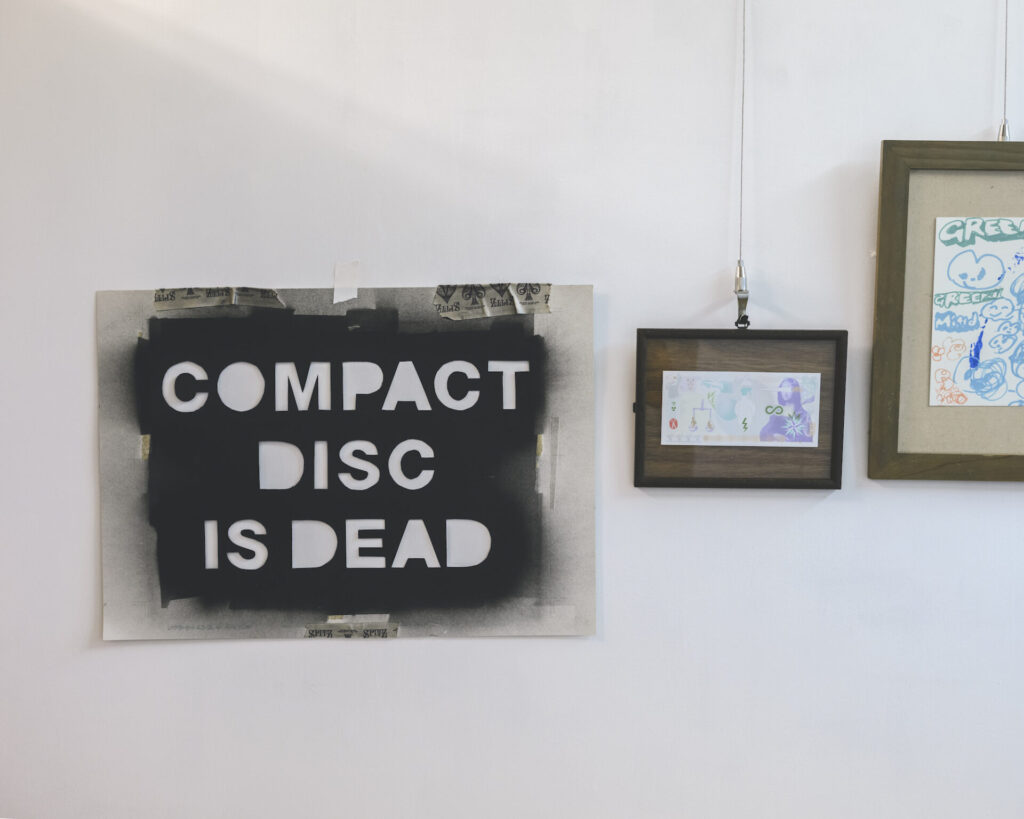
Shigeta: The world of audio recording underwent a similar upheaval. Until the end of the 1990s, it was common to book major recording studios for extended periods, with budgets running into tens of millions of yen. But since the 2000s, the spread of desktop music and personal studios has completely reshaped the economics of recording. It was also the era when the democratization of technology dramatically reduced the cost of infrastructure needed for creative expression.
Kimura: As a result, young musicians today don’t necessarily need designers to propose visual concepts for them. They often carry a clear sense of their visual identity, and within their circles or creative collective, they can create high-quality work across video and graphic design.
Shigeta: I feel that as well. More and more musicians have a strong sense of exactly what they want to create. King Gnu is a typical example of this kind of multi-talented musician.
Kimura: I think this is the result of the specialization and rationalization of the music industry. In a sense, the whole industry reached a state of complete maturity. Today, musicians function almost like independent companies. There are established marketing formulas for what sells and how things are supposed to work.
As a consequence, uncertainty and open-endedness are gradually being optimized away. I personally want to keep some distance from that trend of over-optimization. I think album-cover design remains one of the few areas where the rules of capitalism don’t entirely apply, where a musician’s personal whims and obsessions can still take precedence.

“When an artist possesses that kind of singular locality—something truly impossible to replicate—it can spread across the world under the right circumstances.” (Kimura)
——In today’s increasingly rationalized and systematized world, the archival recordings of Fishmans from the 1990s are being rediscovered and celebrated as historic masterpieces by young listeners and major music criticism sites around the world. How do you see this global phenomenon?
Kimura: Simply put, for listeners overseas, their sound was unlike anything they had ever heard before. In music history overseas, no musical equivalent with a similar DNA existed. Anything that sounds similar today came after Fishmans, not before.
Shigeta: It is said they began their style with dub, a reggae-derived style originating in Jamaica. But the sound they ultimately arrived at was no longer like that. It was completely the accumulation of countless coincidences.
There was the singular high-pitched voice of Shinji Sato, and the fact that the drummer, Kin-ichi Motegi, chose an open-handed style, playing without crossing his arms. I once had the chance to ask him about this when we spoke together. He told me, “At that time, there was very little video footage of drummers available, so I simply didn’t know that playing cross-handed was considered the standard technique.” As a result, he ended up striking the snare with his non-dominant hand, which altered his body mechanics, leading to his unique tempo and a rhythm with a distinctive forward lean.
Then add Yuzuru Kashiwabara’s melodic bass lines, along with ZAK, the recording engineer, who functioned as a band member without an instrument, shaping the entire space. It was the miraculous convergence of all these elements that created the Fishmans sound.
Kimura: Right, that ultimately resulted in a level of originality that simply didn’t exist anywhere else in the world.

Shigeta: When I visited the Fishmans live concert last year at Ariake, roughly 30% of the audience was young fans from overseas, many of them from Asia. Their music carries a unique sense of nostalgia, something like the folk songs a grandmother might sing to a child. I believe that emotional quality is what locality truly means — it’s the essence of cultural expression rooted in a specific place.
Today, as represented in K-POP, much of global pop culture is moving toward increasingly standardized international formats. What struck me when I visited Bangkok, however, was that many Thai artists don’t seem especially interested in conforming to that system.
The Japanese music scene of the 1990s existed at precisely the moment when everything was beginning to converge toward a standardized global format, and it was the band Fishmans that stood in direct opposition to that trend. They represented a culture that retained its own unique texture, atmosphere, and what I would call “humidity”—a sensibility that resisted homogenization.
Kimura: The same thing is happening with guitarist Masayoshi Takanaka, who has recently developed a passionate following among Gen Z listeners overseas. Watching videos of his concerts abroad, I realized it was not sophisticated snobs who were responding to him, but ordinary young people who were completely losing themselves in his sound. For them, the Takanaka sound — that fusion of virtuosic technique and the kind of easy-listening music that might accompany a radio weather report — feels entirely new. In many ways, it is the genuine precursor to what people now associate with vaporwave(*3).
When an artist possesses that kind of singular locality—something truly impossible to replicate—it can spread across the world under the right circumstances.

“Even if a cover may not be particularly impressive as a piece of visual design, if the sound inside it is overwhelmingly great, that cover can suddenly strike you as extraordinarily beautiful — precisely as a signifier.” (Kimura)
——In recent years, some have pointed out that design and marketing often function as a way of compensating for shortcomings in the product itself — that deficiencies in substance are masked by the surface appeal of packaging design. Does album artwork design operate differently?
Kimura: In the world of album artwork design, the logic of using design to compensate for weakness in the sound itself doesn’t really work. If anything, the reverse is true. Even if a cover may not be particularly impressive as a piece of visual design, once you put the record on and hear extraordinary sound from the speakers, that cover can suddenly strike you as extraordinarily beautiful — precisely as a signifier. That’s one of the unique reversals that exists in music packaging.
Shigeta: In today’s business world, making a product seem more appealing through packaging, advertising, and surface-level design — even if it has shortcomings in its underlying quality —is often described as branding. But that’s not branding in any meaningful sense. In that sense, I think the music industry is an unusually pure and fortunate field because it rejects the kind of life support and window dressing that design can provide.
Interestingly, I feel that the field I work in today — cosmetics development, and dermatological science that underpins it — has a very similar structure. Take skin diseases such as atopic dermatitis. These are serious, deeply distressing conditions for those who live with them. Yet why is it so difficult to generate the kind of large-scale social or scientific innovation that might lead to a fundamental cure? When you ask medical specialists, their answer is often blunt: because it isn’t a disease that kills people.
The modern healthcare system naturally prioritizes issues directly connected to life and death, while treating everything else as secondary. However, the things that ultimately determine whether people feel happy or fulfilled often belong precisely to those neglected areas. An itch won’t kill you, but living every day with relentless discomfort is far from what anyone would call a happy life.
Music has an exactly similar nature. If music disappeared from the world tomorrow, human beings would not die physically. And yet a world without music would be one in which human beings could not truly flourish. It is precisely this kind of essential value — found in things that won’t kill you to live without, but without which life loses something irreplaceable — that continues to captivate us.

“What I most prioritize in the context of creative activity is dismantling modern marketing methods, which people often rely on to arrive at the right answer by the most direct route possible.” (Shigeta)
——Today, music has become a kind of public auditory infrastructure, represented in platforms such as Spotify in much the same way that water and electricity are. In that environment, how can we continue to secure truly distinctive forms of expression?
Kimura: Personally, I’ve never really used subscription-based streaming services like Spotify. As a listener, I’ve never felt the need for them in my daily life. Instead, when physical record stores became difficult to visit during the pandemic, I became deeply immersed in Bandcamp, a platform where people can purchase digital music directly from artists.
What fascinated me was the sheer abundance of music that existed outside the established global distribution networks. There were countless tracks from obscure corners of the world — music unlike anything I had ever encountered before. That sense of discovering entirely unfamiliar forms of expression is deeply tied to my own creative activity.
Shigeta: What I most prioritize in the context of creative activity is dismantling modern marketing methods, such as KPIs and personas, which people often rely on to arrive at the right answer by the most direct route possible.
Genuine emotion never emerges from methods designed to optimize performance for the predefined target within the hierarchy of those who commission and those who execute. What I’m really after is the process itself — creators from different fields standing on equal footing, embracing unpredictable errors and noise, and drifting together toward an unexpected destination that surpasses anything any of them imagined.
What matters is how to abandon intentional logic and accumulate the fruits of chance.
Kimura: In reality, creating album artwork is also a continuous “game of telephone,” with many people passing messages along the way. For example, a musician says they want to add a black horn on their head, and a photographer shoots without me present. As a result, the black of the background and the horn bleed into each other and effectively disappear — these kinds of errors often happen. In the end, I brought things into focus through retouching the images in Photoshop. However, when the artist embraces these unpredictable errors or the unexpected interpretations a stylist brings — finding something compelling in them — that’s when the fruits of chance emerge. In that sense, my approach to design is similar to yours.
By the way, Mr. Shigeta, I have a question. You changed careers from recording engineer to the world of cosmetics, and you now run a cosmetics company. When you worked as an engineer, what did you want to do most?

Shigeta: I played saxophone in junior high school and DJ’d in high school, and somewhere along the way, I came to see music as the medium through which I could most freely express myself. I wasn’t good at playing instruments, so I really longed to support musicians and help create something great together. I joined a music studio, but I found the recording sessions that came in day after day were the opposite of what I wanted to do. Eventually, my body simply started to reject it, and I left the studio.
Later, I started a live music venue in Takasaki together with my local friends, but it went out of business about a year later. It was then that I realized: if I wanted to pursue the music I truly cared about, I needed money to return to it on my own terms one day. And so I made a clean break from music entirely, determined to build the financial means to do so. That path led me into the world of cosmetics and beauty, and I’m where I am today.
——What was your ideal form of involvement with music at the time?
Shigeta: One image that has always stayed with me as an ideal is what I encountered at the Orchard Hall when I was in junior high school — the relationship between a concert by the jazz musician Sadao Watanabe and his sponsor, Shiseido. After the concert, small vials of perfume were handed out to the audience — that scene has never left me. The sense that the memory of music and the memory of scent become absorbed into the body as a single unified experience struck me as deeply romantic.
So, my path led me from music to running a cosmetics company. When I held an event at ADRIFT in Shimokitazawa last year, I gave attendees a scent to take home— a direct echo of that memory at the concert. And the project I worked on with Mr. Kimura is an extension of that.
What I want to do is not merely to consume the past nostalgically, but to awaken in people a sense of discovery they have never felt before, simply by presenting what is genuinely good as genuinely good — here, now, in this moment. One day, as one of my biggest whims and obsessions in my life, I want to make a solo album with the saxophone, a sequencer, and rappers I trust. Just like Tommy Guerrero, musician and skater, opened a can of Heineken beer immediately after stepping onto the stage and launched into an unhurried, free improvisation, I want to escape the pull of optimization and keep shaping a future that is itself a fruit of chance.
Kimura: I see.
——Our aim for this conversation was to draw out Mr. Kimura’s deeper thoughts. But I’m not sure we could…
Kimura: I’m afraid it’s impossible in an interview of an hour or so. (laughs)
Shigeta: Personally, sharing our sense of unease toward the systems underlying each of our creative practices made this conversation truly rewarding. Thank you so much for your time today, Mr. Kimura.

Notes:
*1_SUPERCAR / Futurama
Since their debut in the late 1990s, SUPERCAR defined Japanese rock with their exceptional songwriting and experimental sound, before disbanding in 2005. Released in 2000, their third album, Futurama, is widely regarded as a landmark record that expanded the horizons of J-POP through its pioneering incorporation of electronic and trance elements. Designed by Yutaka Kimura, the album artwork gave tangible form to the record’s forward-looking musical vision, and it continues to resonate as a striking work of conceptual art.
*2_Fishmans
Fishmans is a legendary Japanese band that forged a singular sound during the 1990s. This year marks the 30th anniversary of two of its most celebrated works, Kuchu Camp (Something in the Air) and LONG SEASON. In an age increasingly shaped by the logic of global efficiency, the band’s music remains remarkably fresh. Shinji Sato’s unmistakable voice, combined with a sound born of happy accidents and the singular contributions of its members and engineers, produced a combination unlike any other — one that refuses to fade. Today, Fishmans continues to perform live under the leadership of drummer Kin-ichi Motegi, collaborating with a lineup of guest vocalists.
*3_Vaporwave
Vaporwave is one of the artistic and musical movements that emerged from internet culture in the early 2010s. It is characterized by the deliberate manipulation and distortion of the visual imagery of early personal computers and commercial music associated with the mass-production and mass-consumption culture in the 80s and 90s. Vaporwave developed a distinctive aesthetic that critically reflects on the hollowness of the bright futures humanity once imagined. In today’s fully digital age, this unique sensibility has found a global audience, particularly among Generation Z, who often experience it as a form of “nostalgia for a time they never lived through.”
Profile
-
Yutaka Kimura
Born in 1967, Kimura joined Sony Music Communications after graduating from a vocational school for graphic design, before founding his own design studio, Central 67, in 1995. Since then, he has created an extensive body of album artwork and served as visual director for some of the defining artists of modern Japanese music, including Spitz, Ringo Sheena, Hikaru Utada, and SUPERCAR.
Known for his ability to give physical form to the invisible emotions, excitement, and worldviews contained in music, Kimura has often been described as someone who helps shape the kind of happiness that lies beyond mere survival — a figure so integral to Japanese popular music that “J-POP would be in trouble without him.”
www.central67.com -
Masakazu Shigeta
Shigeta began his career in a technical role in the music industry before becoming a cosmetics developer in 2001. Beginning in 2004, he led the development of various cosmetics brands within the healthcare division of Nitto Denka Kogyo Co., Ltd., a metal surface treatment company founded by his great-grandfather. In 2017, he founded OSAJI, a skincare lifestyle brand, and became its brand director. In 2021, as a new store under the OSAJI brand, he launched kako, a specialty shop dedicated to home fragrance blending, and in 2022, he opened OSAJI’s first restaurant, enso. In 2023, leveraging Nitto Denka Kogyo’s technical expertise, he launched HEGE, a tableware brand, and became CEO of OSAJI Inc. in October of the same year. In 2026, as a personal project, he opened Shirakabaso, a private rental lodging facility in Sarugakyo Onsen, Gunma Prefecture, and launched OSAJI Kyoto, the brand’s global concept store in Kyoto’s Gosho Minami district. In the same year, he launched soca, a fragrance brand rooted in Japan’s unique aesthetic sensibilities. He has published books on beauty and regularly holds cooking classes and events focusing on food as the foundation of beauty.
Publications
Taberu Biyou (Eating for Beauty) (SHUFU TO SEIKATSU SHA, 2024)
42-Sai ni Nattara Yameru Biyou, Hajimeru Biyou (Beauty Routines to Quit and Start at 42) (Takarajimasha, 2022)
Information
FINE HALL
Opened in June 2026, FINE HALL is a new gallery space located within Yutaka Kimura’s studio in Shimokitazawa, Tokyo. Its inaugural exhibition, on view through June 14, 2026, is a group show featuring five artists exploring the theme of “Nostalgia.” In addition to exhibiting and selling paintings, ceramics, sculptures, and drawings, the gallery also carries original goods by each of the participating artists.
www.finehall.gallery
-
Photographs:Eisuke Komatsubara
-
Text:Masahiro Kamijo


NEWS LETTER
理想論 最新記事の
更新情報をお届けします
ご登録はこちら
ご登録はこちら
メールアドレス
ご登録ありがとうございます。
ご登録確認メールをお送りいたします。