

2026-04-16
Vol.26
Stylist
Masako Ito(part 1)
-
What Does It Mean to Fall in Love with Things and Experiences?
-
The Words of Mother Teresa
-
The Nature of Fascination — Antique Hunting and Mushroom Foraging
-
The Boundary Between the Everyday and the Extraordinary
Four years ago, they reaffirmed the importance of a discipline: staying true to oneself. Since then, stylist Masako Ito has been gracefully reimagining her way of life. Every seven years, she deliberately lets go of the career she has built, only to weave it into a new form — a personal, healthy ritual that keeps her sensibility constantly fresh.
She calmly clears away unnecessary information, puts her surroundings in order, and resets her body and mind with a cup of sayu — plain hot water. The discerning eye she has cultivated through this process is now drawn to antique hunting at flea markets.
A pure sense of “falling in love” with things and experiences — haven’t we, in today’s world so focused on finding the right answers, been discarding that inexplicable excitement and wonder? In this conversation, they explore that rich inner heat — the kind that moves the heart beyond reason.

“I think ‘falling in love’ can be understood in many different ways — it can also describe those moments when you become deeply absorbed in something, whether that’s an object or an experience.” (Shigeta)
Masakazu Shigeta: We’ve had the chance to speak together before at a talk event at the department store Isetan, but this is our first time sitting down for a proper conversation since 2022. And I also had the pleasure of visiting your villa in Karuizawa last year, but this is the first time we’ve seen each other this year. Thank you for joining us today.
Masako Ito: It’s a pleasure to be here. Thank you for having me.
Shigeta: It’s been two and a half years since we started this series, Idealism.
Ito: That’s impressive. What specific moment or need inspired you to start the series?
Shigeta: The motivation has gradually changed over time, but what initially drove me was the sense of urgency — the feeling that many people had stopped talking about ideals and hopes. After the pandemic, it seemed to me like everyone had become much more pragmatic, viewing everything through a strictly realistic lens.
That said, I was also sure that people still carried their own visions within them. They just weren’t putting them into words. So, by bringing those unspoken ideals into conversation, I thought something interesting could emerge. It could create a synergy that not only energizes the people involved but also offers new perspectives to others. I simply wanted to hear how the artists and business people I’ve had the pleasure of knowing or have long admired are thinking. What drives them? What vision of the future do they hold as they navigate the present? I thought there should be a place for that kind of perspective, even if it’s just a small corner of a media platform. That’s why I tend to invite people who are “wonderfully unconventional.” (laughs)
Ito: I suppose a doctor based in Karuizawa also appeared before, right?
Shigeta: You’re thinking of Dr. Toshiro Inaba.
Ito: Yes, that’s him. I actually met him briefly once. I found him a refreshingly easygoing and charming person.
Shigeta: He is someone who navigates between medicine and art. So, in a series like this, where we’ve invited such distinctive figures, you might wonder why I asked you to join today…
Ito: That’s exactly what I want to know. There is a theme for today, too, right? “Love,” or something along those lines?
Shigeta: That’s right. A bit unexpected, I suppose.
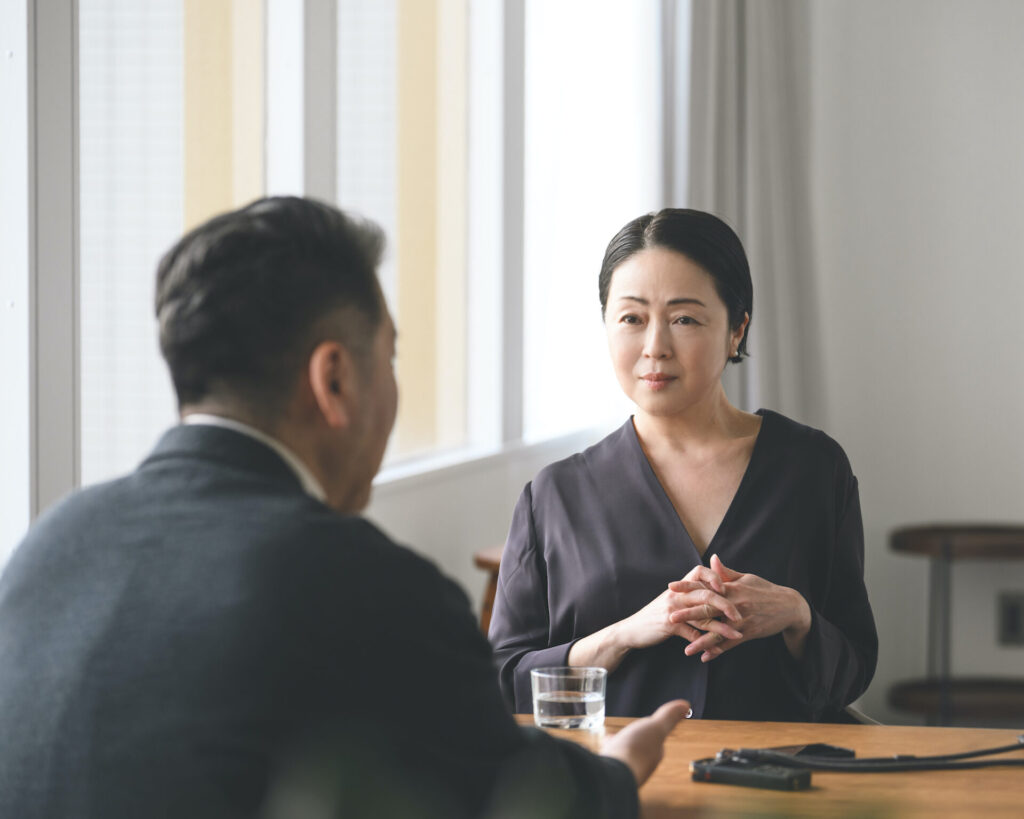
Ito: When you told me the theme, my first reaction was, “What?” You know, I’m not very fond of love songs and love stories. So, I honestly wondered if you’d picked the wrong person for this — I was a little nervous yesterday, thinking, “What’s this going to be like tomorrow?”
——In the conversation featured in Mr. Shigeta’s 2022 book, 42-Sai ni Nattara Yameru Biyou, Hajimeru Biyou (Beauty Routines to Quit and Start at 42), the central theme seemed to be the “comfort of staying true to yourself,” including Ms. Ito’s morning routines. Shifting from that focus, today’s theme — love — feels highly dramatic, something that stirs and uplifts the emotions. It almost seems to stand at the opposite end of the spectrum from the theme of the previous conversation.
Shigeta: I think “falling in love” can mean many things. It may refer to romantic love, or to moments when you become deeply absorbed in something—an object or an experience.
Actually, from the end of last year into the beginning of this year, I wasn’t feeling well, both physically and mentally. It was the first time I’d ever felt so physically depleted.
Ito: Oh, really? I went through something similar at the end of the year two years ago. But after a while, I started to feel much better again.
Shigeta: In my case, it started around December, and I wasn’t in great shape throughout January. From February, I was back to full energy.
Ito: I always thought that kind of thing mainly happened to women.
Shigeta: It started with a slight fever, but gradually it began to affect me mentally as well. In the end, for the first time, I had to deliver my New Year’s address to the staff online. On that day, I still wasn’t feeling well, so I had no choice but to say, “I’m sorry, I don’t think I can make it to the office today.”
Ito: What was the cause?
Shigeta: I had a fever, and it just wouldn’t go away. I’d been unwell before, but I had never let it affect my work. I’d always believed that as long as I had work and was mentally focused and motivated, I could push through anything. But this year was different. I had to reschedule a lot of plans in January.
Ito: It’s really hard to let others down because of yourself. But sometimes, it’s important to pause and take a step back.

“What I came to realize, once again, is that doing something to make people happy is what excites me — it’s my own form of ‘falling in love’.” (Shigeta)
Shigeta: The start of the year is an important period because we need to set our direction for the new term beginning in April. But this year, I just couldn’t find the motivation — I didn’t even know how to bring it back. In those moments, ideas like “return to the origin” inevitably come to mind — Why did I start making cosmetics in the first place? Why do I cook? What I came to realize, once again, is that doing something to make people happy is what excites me — I believe it’s my own form of “falling in love.”
Mother Teresa once said, “The opposite of love is not hate; it’s indifference.” I’ve always loved that quote, and I mentioned it when presenting our plans for this year to the staff. That said, a thought crossed my mind: Does that mean interest is the same as love? But when I put it that way, it didn’t quite feel right.
Love feels like something that’s already a part of us — it simply exists, and it’s almost impossible to imagine it not being there. Seen in that light, what we call “interest” might be closer to “falling in love” than to love itself.
Ito: So, are you saying that interest is equal to the sense of “falling in love”?
Shigeta: I took Mother Teresa’s words to suggest that, even within love, there needs to be that element of falling in love — that sense of genuine interest and excitement. At the same time, I came to redefine making cosmetics and being involved in the beauty industry as something that cultivates that feeling within people. So, I told my team, “Our theme for the coming year will be ‘cultivating a sense of falling in love.’”
Ito: How did they react?
Shigeta: When it’s taken to mean romantic love, some people seem to feel a bit of resistance. One of our female staff members even said to me directly, “Not everyone falls in love.”
Ito: I can understand that — if you’ve been with the same partner for decades, there are probably people who rarely feel that kind of excitement anymore.
Shigeta: Exactly. So, I expected there would be mixed reactions if it were understood in a romantic context. But when I expanded the idea to include being absorbed in things or experiences, people responded much more positively, like, “Now that works.”

“The more I learn, and the more I see, the more something will suddenly catch my eye and seem to glow among all the clutter.” (Ito)
Ito: I was with my daughter before I came here. When I told her that I was about to have a conversation with Mr. Shigeta on the theme of “falling in love,” she said, “Mom, whenever you find something you’re into, you just dive right in — why not talk about that?” And I thought, “That’s it!”
Right now, I’m completely absorbed in collecting antiques. When I was chatting with the owner of a gallery and mentioned I’d been enjoying visiting flea markets, they said, “We’d love to display something you’ve selected here.” That’s how my weekend flea market visits began.
Shigeta: Which kind of flea markets do you go to?
Ito: All kinds of places. I just wander around thinking “Oh, this is lovely — and so is that.” I was first interested in ceramics, and then my interest expanded to baskets. The more I learn, and the more I see, the more something will suddenly catch my eye and seem to glow among all the clutter — like it’s calling out to me.
It’s exactly like foraging for mushrooms or wild plants — at first, everything looks the same, but once you get the knack, you start seeing them everywhere. “Oh, there’s one, and there’s another.” I’ve come to recognize that same instinct in flea markets, and I find it fascinating. Right now, I feel like I’m truly “in love” with antiques.
——Whether it’s people, things, or even business, we often become so absorbed at the beginning that we forget to eat or sleep. But over time, that feeling tends to fade away. Why do you think that happens?
Shigeta: It’s been almost ten years since we started OSAJI, but I feel the same way I did from the very beginning. I take pride in being someone who can sustain a sense of excitement and curiosity. I’m always thinking about how to maintain that mindset, and I set tasks for myself to make sure it continues. That might be one of my strengths.
But as more people become involved, their individual sensibilities inevitably blend into the brand color — our identity. I’ve always said that “The sense of falling in love is the most important element in beauty.” It’s scientifically proven that being deeply absorbed in something makes people more beautiful — more than any high-quality cosmetics ever could.
That said, as more people contribute and bring their own perspectives, things can sometimes drift away in the exact opposite direction of what I originally wanted to offer the world. I’ve found myself feeling that more and more lately.
Ito: Do you think that’s an inevitable process for a company or a brand to grow further?
Shigeta: Well, part of it probably comes down to how I’ve been involved. Maybe I haven’t been consistent enough in communicating my vision, or I’ve prioritized the team’s perspectives too much. And then one day, I realized, “Wait, this might not be the direction I originally had in mind.”
When I fell ill toward the end of last year, that realization really hit me, and it brought me down quite a bit.
Ito: Oh, really? Does that mean things are now completely different from your original vision and ideal?
Shigeta: Not entirely — I find some of what we make is very close to my ideal. But especially when it comes to how we communicate or present products, I’ve been having more moments where I think, “Maybe we should refine this a bit more before putting it out,” or “Let’s take another look at whether the writing in this brochure is truly beautiful.”
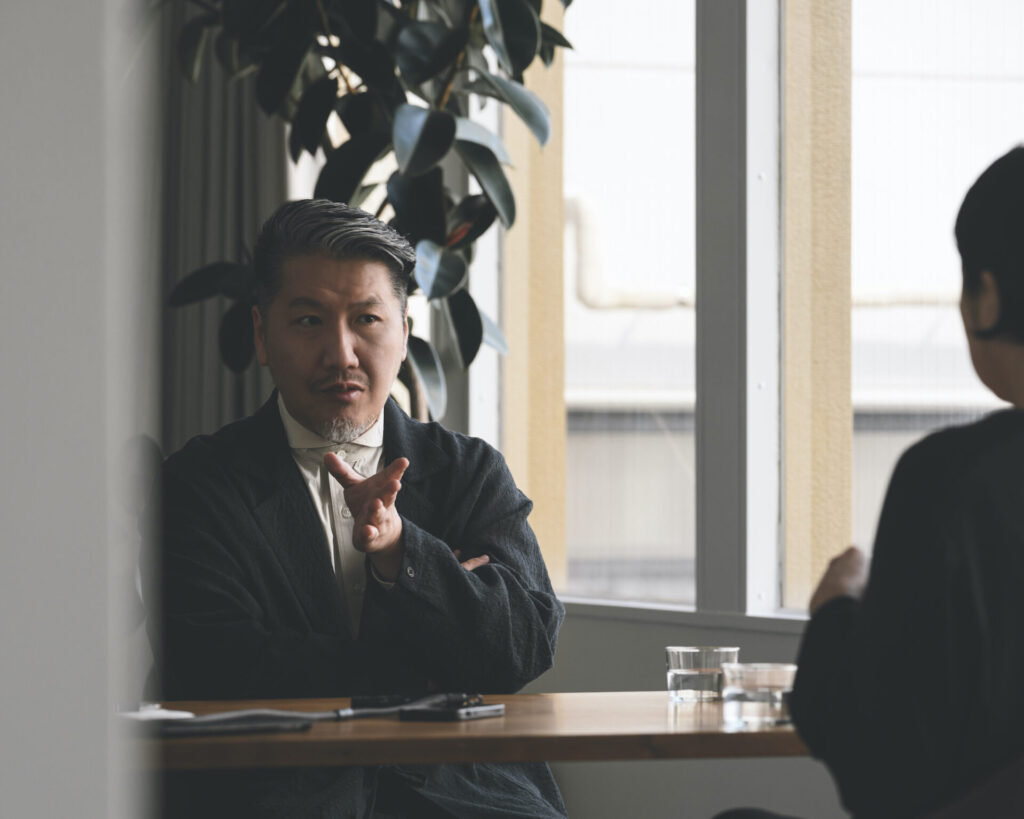
“I think the sense of falling in love is closely linked to that kind of departure from the everyday — and being in an unusual situation allows me to bring out an incredible level of performance.” (Shigeta)
Ito: Something you once told me really stayed with me: “Because we work with many people in our company, we don’t need to aim for 100% — 70% is enough.” Hearing that, I remembered thinking, “That makes sense.”
I’ve worked as a freelancer for a long time, and I have always wanted to give 100% — and I believe I did. But now that I work as part of a team, whenever things don’t go as I’d hoped, I often find myself coming back to those words. “Right, if I get stuck here, I won’t be able to move forward, so this is enough for now.”
It’s not about being careless or cutting corners — it’s about allowing myself to accept. “This is enough.” Your words have really been a source of support for me.
Shigeta: I’m really glad to hear that. When we work as a team, everyone might be aiming for a perfect 100, but the closer we try to get to that ideal, the more it can end up moving away from someone else’s idea of 100 — that’s just inevitable.
If it ends up being something like a 40, maybe it wasn’t meant to be a team effort in the first place. But for me, if it’s at 70 or 80, I’ve always felt it’s more important to move forward and see what comes next rather than dwell on indecision.
That said, toward the end of last year, a thought suddenly crossed my mind: Are we really creating something that reaches 90 or 100 for anyone? Maybe it doesn’t even reach 70 for me.
Over the past year, I’ve been working to reassess and reorganize the company. I suppose all that stress caught up with me at the end of the year.
Ito: You mentioned earlier that your mindset and motivation haven’t really changed, but I’m the opposite — I get bored very easily. But that’s probably also why I’m able to do many different things under the title of “stylist.”
Something I’ve recently realized is that what people actually expect from me is to keep doing what I genuinely enjoy — what I truly feel is “good.” It’s not about “this will sell well,” but rather “this is what I want.” Since coming to that realization, I’ve started to feel that I’m in a very fortunate position in my work.
Shigeta: I’m actually quite the same — I get bored easily, too. But I think being a stylist for you is like OSAJI for me. As long as I’m working within that framework, I never get bored — whether it’s running a restaurant or a cafe. I think that kind of foundation makes all the difference.
By the way, something you said has also stayed with me. When we were talking about the rise of subscription-based vacation homes, I mentioned that many of those places deliberately offer unironed sheets and bedding, and you said, “I absolutely hate that” (laughs).
Ito: Did I really say something like that?

Shigeta: You did — you said, “Hotel sheets must be crisp.” Embracing that kind of relaxed, lived-in feel is very much in line with the times, isn’t it? Not trying too hard to create a sense of the extraordinary.
Ito: I see. But if I’m staying at a hotel, I would still want that sense of the extraordinary…
Shigeta: Personally, I think that the sense of falling in love is closely linked to that kind of departure from the everyday. During the COVID lockdown, while other business leaders were panicking and saying, “This is going to be tough,” I actually felt my motivation rise. For me, being in an unusual situation brings out an incredible level of performance. So creating those kinds of moments within everyday life has become a sort of personal challenge.
Ito: What were you actually doing during that time?
Shigeta: You know, all our stores had to close at once. But many of our staff still wanted to work, so we quickly set up our own logistics center. With the stores closed, online orders surged, but we couldn’t handle them well because our outsourced warehouse was overwhelmed and couldn’t keep up. So, we found an available warehouse ourselves, transferred our inventory, and handled shipping together with the store staff.
We were constantly figuring things out — how to reduce shipping errors, rearranging the office layout, even making disinfectant spray… And at the end of each day, we’d gather in the parking lot and have canned beers together.
Looking back, that extraordinary time was genuinely enjoyable. Our staff, who were usually well-dressed and serving customers in stores, suddenly found themselves doing completely different kinds of work, tackling them by trial and error and giving it their all.
In that sense, too, I think I’ve always been conscious of how to bring a kind of “non-work thinking” into my work.
Ito: In my case, life is part of my work, and work is part of my life. When I’m out for a walk and spot wild plants growing, I think, “This leaf looks beautiful — I might try displaying it in the living room. And if it works, maybe I’ll use it in a shoot.”
Sometimes, even the color combination in the meal I cook leads to ideas for work. Everything is connected like that, so people sometimes ask me, “Don’t you ever get tired?” But I don’t, really.
That’s why I’m not even sure what counts as everyday life and what doesn’t. But I do get excited when I travel — and when I do, I want the hotel sheets to be crisp. Maybe that’s because I’m looking for something out of the ordinary…well, who knows…
Shigeta: When I visited your villa in Karuizawa, it felt so uncluttered and impersonal that it could almost be a guest space.
Ito: I like things to feel crisp and in order. Even when I’m relaxing, it’s almost like I’ve decided, “Now I’m going to relax.” It would probably be better if I could do that more unconsciously, though.
(to be continued in the second half)

Notes:
42-Sai ni Nattara Yameru Biyou, Hajimeru Biyou (Beauty Routines to Quit and Start at 42)
Published by Takarajimasha in 2022, this book by OSAJI brand director Masakazu Shigeta, drawing on his dermatological expertise, proposes a “subtractive” approach to beauty, encouraging readers to reassess their habits at age 42, often seen as a turning point for both mind and body. More than just a guide to beauty routines, the book emphasizes the importance of shaping one’s life around a personal sense of comfort, resonating with a wide readership. The volume also features a conversation with stylist Masako Ito, this issue’s guest, exploring the discipline they share — staying true to oneself — from the perspectives of both daily life and beauty.
Profile
-
Masako Ito
Born in 1970 in Yokohama, Kanagawa Prefecture, Masako Ito is a stylist who proposes ways of living encompassing cooking, lifestyle goods, and fashion. Her refined aesthetics and graceful, attentive approach to daily life have earned her a wide following across generations. She is also the author of numerous books, including Haha no Recipe Note kara (From Mother’s Recipe Notebook) and Suru, Shinai. (Do, Don’t.). Since 2018, she has hosted weeksdays on the Hobonichi platform, giving form to what she “truly wants.” In 2020, she collaborated with OSAJI to develop two original fragrances, Mezame and Nemuri, inspired by her morning and evening routines. She renews the core of her career every seven years. Currently, she focuses on collecting antiques and rethinking living spaces — continuing to weave new forms of life with a constantly fresh sensibility.
-
Masakazu Shigeta
Shigeta began his career in a technical role in the music industry, before becoming a cosmetics developer in 2001. From 2004, he was involved in developing various cosmetics brands within the healthcare division of Nitto Denka Kogyo Co., Ltd., a metal surface treatment company founded by his great-grandfather. In 2017, he founded OSAJI, a skincare lifestyle brand, and became its brand director. In 2021, as a new OSAJI store, he produced kako, a specialty shop for home fragrances and perfume in Kuramae, Tokyo. In the following year, he opened a combined shop in Kamakura, Kanagawa, featuring OSAJI, kako, and the restaurant enso. In 2023, leveraging Nitto Denka Kogyo’s technical expertise, he launched HEGE, a tableware brand, and in October of the same year, he became CEO of OSAJI Inc. He has also published books on beauty and regularly holds cooking classes and events focusing on food as the foundation of beauty. In November 2024, he released a collaborative album with F.I.B JOURNAL titled Gensho hyphenated, further expanding the scope of his creative activities.
Publications
Taberu Biyou (Eating for Beauty) (SHUFU TO SEIKATSU SHA, 2024)
42-Sai ni Nattara Yameru Biyou, Hajimeru Biyou (Beauty Routines to Quit and Start at 42) (Takarajimasha, 2022)
Information
weeksdays
Launched in 2018 in collaboration with Hobonichi, weeksdays is a project spanning clothing, food, and lifestyle. Rooted in Ito’s pure pursuit of “what I truly want,” the project covers a wide range of categories from kitchen tools to clothing. Backed by her refined aesthetics and years of expertise, the project has earned the trust of many readers for its approach to creating products unbound by conventional frameworks. It has collaborated with trusted creators and makers, including joint fragrance development with OSAJI.
https://www.1101.com/n/weeksdays/
-
Photographs:Eisuke Komatsubara
-
Text:Masahiro Kamijo
-
Make-up:Yuya Goto (OSAJI)
NEWS LETTER
理想論 最新記事の
更新情報をお届けします
ご登録はこちら
ご登録はこちら
メールアドレス
ご登録ありがとうございます。
ご登録確認メールをお送りいたします。